Sunday, February 12, 2012

Unpacking fairytales in Perth

Whenever I go to a really good storytelling show, I'm surprised again at how moved and excited and hyped up I get. Friday night I went on a bit of a road trip to Perth with my friends Ruthanne and Talia to see "The Brothers Grimm: 200 Years and Counting" with storyteller Dale Jarvis and musician Delf Maria Hohmann. Absolutely glad I went.

The show was at Full Circle Theatre in Perth, which, I'm told, is a redesigned car wash. It's a really lovely little theatre, and has something of the flavour of an old auto shop about it, although I'm not sure exactly how. Maybe it's the big, garage-looking wooden panels at the sides of the stage, or the high ceilings.

Dale and Delf have put together a show that weaves together the life stories of Jacob and Wilhelm Grimm with some of the stories they collected and German folk music (Delf played the music, on guitar, banjo, whistle and dulcimer, and sang.) There were all sorts of things I hadn't known about the Grimm brothers, and a ton of fascinating facts woven into the story about who they were, why they started collecting stories, and the people they collected them from. There were stories about the brothers becoming celebrities, and unwitting political exiles, and a lovely bit played from the point of view of a self-important Hans Christian Andersen (who apparently once came to visit the brothers, and picked the wrong one to try and impress.)

And then there were the fairytales themselves, which were the original stories. Decidedly not the Disney versions. Some parts of these stories were actually pretty disturbing, especially told with the obvious relish for the gruesome bits that Dale showed. (His description of a father unwittingly eating a stew made of his youngest child was curdling. So was the story of the evil bishop plagued by an army of rats. That one actually made me squirm.)

These are weird, weird stories at times, too. As the evening went on you got a feel for them, for the place and culture behind them, and I started wondering, with some of the odder parts of the stories, what older myths they might be fossils of. Bits of The Juniper Tree in particular: which, if you know it, is one seriously strange story.

There were a couple of themes that kept coming back: magic trees growing out of graves, stepmothers eating their children, birds that sing the truth. And having even the familiar stories told in the old versions, and in the style that Dale told them, made me look at them new. I could actually listen to the story of Cinderella - oh, sorry, I mean Aschenputl - with new ears. For one thing, he told the German version. The one with no fairy godmother, but a magic tree and a pair of magic doves. The one where the sisters chop off bits of their feet to get them into the shoes, and the doves call them on it, and eventually pick their eyes out at the wedding. (The other version, which most of us are more familiar with, is actually a French version.) It made it new, and that meant, for me, that a vague sense of the people and the place - a little kingdom in the middle of what would eventually be Germany in the 1800s - started to build, as though I hadn't really imagined them before.

It was partly the style in which Dale told the stories, and partly the German songs that linked them together, and partly the stories that he chose, but I was suddenly thinking of the stories in Joseph Campbell terms. The stories unpacked themselves and I started glimpsing huge swaths of meaning behind them.

Dale ended with the story that the Grimm brothers always ended their collections with - the Golden Key. It's a strange little story that sounds just a little bit like a koan or a parable. A boy finds a small golden key in the forest, in the winter. He figures, where there's a key, there must be a lock, and looks around in the snow. He finds a small iron box, and fits the key in the lock. He turns it once. And we will only know when he finishes turning the key what is inside the box.

Monday, January 30, 2012

Catching up on the last two weekends...

It's been a crazy couple of weekends - particularly VERSeFest-wise. . .

The two pre-Festival events were both very cool in their own different ways. Poetry For the End of the World was jam-packed with poets, open mikes, and music: I couldn't catch everything because I was running back and forth, but what I did catch was fun. I got to hear a couple of Call Me Katie tunes that I hadn't heard before, including their last number, which was lovely and surprisingly science-fictiony. (Any folk tune that includes lines about how "the ships are gonna burn... burn up on reentry" wins points with me.) I watched the finalists for the Poetry for the End of the World contest read, but missed the featured readers because I was busy running around to the loading dock at Arts Court to get photos of the weather balloon waiting for launch:


At about 10:00, we all headed out to the side of the building (well, not all: a few people didn't feel like heading out in the cold, but some brave souls crunched out to watch.) And the winning poem (Ian Ferrier's "Letters from the Ice Age") was launched to the end of the world. I had my iPhone with me and got video of the whole thing, then had a little fun at home with video editing.


Then we went back inside to see Puggy Hammer, who were a whole lot of fun, although by that time, admittedly, the audience was a bit diminished and a little tired.

Friday I made it out for Once Upon a Slam, although I didn't have a story prepared (I know what story I wanted to tell, I just didn't have time to get it ready.) It was a small crowd and a small slam - the weather was brutal, which probably accounts for that - but with four storytellers signed up there was enough to have one. Anne Nagy claimed the win with a squick-inducing story about trying to be a 'domestic goddess' as a young wife, and a batch of rose hip jelly gone horribly, wrigglingly wrong.

The feature was Luna Allison with a set of stories called "Girl Fail" - which I was really looking forward to, since, well, I've been known to girlfail on occasion myself. Luna was sick, which sucked some of her energy, but in particular she lit up for the excerpts she did from her upcoming Undercurrents show "Falling Open." And her stories were lovely - from a story about a motherless girl struggling at being a 'girl' and then being saved by the riot grrl movement, to a monologue in the voice of a cross-dressing man, to a story of a failed Brownie Hallowe'en party - how was Luna supposed to know that showing up as a dead person stabbed in the back would freak out all the princess-costume-clad Brownies? - to a poignant story about a trans man living a culture that celebrates the birth of boys more than girls - and didn't know that he was a boy.

Strangely enough, I just found a video that Robin LeWilliam-North made of the story he told in the slam: he's just an oddly creative, surreal dude.


Taming the Tides of the Earth from Robin Le William-North on Vimeo.

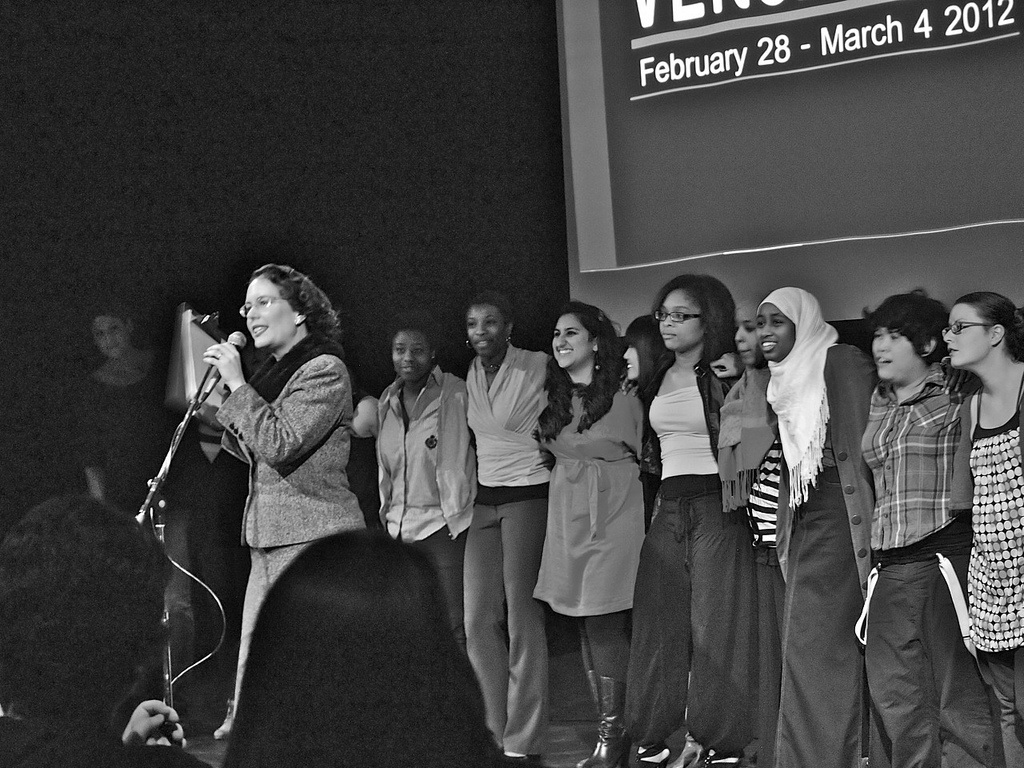
Then there was last Saturday - the Women's Slam Championships. I knew it was going to be crowded, but I guess I wasn't expecting the massive sell-out that we actually had: there were people sitting outside in the studio to listen over the speakers. In fact, in a moment of chaos as the last seats were selling, we wound up selling more tickets than there were seats in the theatre (there were some people sitting on the floor who shouldn't have been, for one thing: for another thing there was a miscommunication about how many seats there actually are) and I had a fairly wrenching few minutes where I had to tell some people who I had let in at the last minute that I was going to have to give them their money back. The show had already started, and I was starting to freak out about what we would do.

But, then, all twelve of the poets, sitting in the front row, spontaneously got up - as one, to a woman, without even conferring among themselves that I could see - and offered their seats, and went to watch the show from backstage, where they could hear but not see. I got a little emotional. It was a beautiful moment. Afterwards, the ones I talked to said things like, "Well, of course we did, we couldn't make people leave that wanted to see the show," and "It was actually more fun back there because we could cheer each other on more."

I'm not kidding, by the way: that's how mutually supportive, generous-spirited and group-huggy slam people are in this town. It's like the Care Bear Stare. It's enough to make a cynic run screaming.

I listened from outside, where I was watching the merch table, but caught enough of the show to know that there was no way to guess the winner. The scores were amazingly consistent, and right up till the end, it could have been anyone's game to win. All of the poets were solid. Rage lost points when nerves chopped up her poem in the first round, but she came roaring back in the second. I was glad to have a chance to see more of CauseMo and Scotch, both from the Youth Slam Team, and get a sense of their work. Scotch in particular blew the audience away with her second-round poem.

At the end of the night the scores had all been so close I had no idea who would be named. And then Rusty and Ruthanne had to confer with the poets - there was a tie. So they asked if the poets wanted to have co-champions, or a slam-off. Of course they said co-champions. So Ruthanne went back to the audience and told them we had a tie for first - between Sepideh and D-Lightfull. When the cheers died down, she said that we also had a tie for third - between Festrell and Elle P.

That's how close it was.

Like I said, I was listening from outside for most of the show, but Pearl Pirie got some great photos and posted them on Flickr. Some of my favorites:
Sepideh (Co-Champion)

D-Lightfull (Co-Champion)
Elle P (Co-runner-up)
Festrell (co-runner-up)


Judges, raise your scores!
Rusty (in the front) and me (in the back) talking to journalists at the break.
The twelve poets take a bow: host Ruthanne in the front.


Tuesday, January 24, 2012

Poetry mashups with Pearl

I have really not had enough time lately to work on writing my own stuff, but over the last couple of weeks I've felt those little twinges again: lines I want to write down, stories nudging to be told, and that sense that somewhere, at some point, my "new" poems are waiting for me to open the right door for them.

Between that nagging urge to write stuff, and the fact that I've been working at home, and so for the last three days I've not really seen anyone else, I decided I had to pick myself up and go to the workshop at the Tree Reading Series tonight. So I did.

The workshop was being run by Pearl Pirie, who's coordinated the Tree Seeds workshops for a while now. I've been to other workshops with her, and one thing I really like about how she does them is that she gets you to play. It's sometimes hard to get a group of poets (particularly older poets, or poets who are firmly rooted in older traditions and styles) to play: this workshop had a couple of people who were initially pretty uncomfortable with taking apart and reassembling their poems. As though they'd break the original poems by messing around with them. But she's so easygoing about it that most of them ended up giving it a good solid try, and being surprised, I think, with the results.

What she had us do was take two of our poems and break them down the middle, by splitting each line into two grammatical parts, more or less at will. Then we spliced the first half of each line on poem #1 with the second half of each line of poem #2, ignoring whether it made sense or not. Then we took the strange Frankenstein's monster we'd just made and looked it over for interesting images, startling juxtapositions, things that worked when spliced together in a way that our conscious mind wouldn't have come up with. It's not that what we were making was in any way a finished product: it was a new starting place, or places, from two old poems.

I found it kind of satisfying just copying out the broken halves of the lines. Meditative. Sometimes a line or two, next to each other, would sound good or give me an interesting image in itself, but I'd leave it to come back to and keep copying. It was like digging new ideas out. I drew a line down the middle of the page and copied the first halves, then the second halves, and reading just the first-half side I'd see patterns and juxtapositions:
dinosaur heads
of construction
and the day
into a finished puzzle box
my body
the passing bus
overhead
of the streetlights
and go
Then as I started filling in the spliced second half, the lines that were created started to surprise me. Even make me laugh. This chunk in particular stood out for me (I did have to switch a couple of pairs of lines for each other and change some subject-verb agreements, and drop out a couple of useless line-segments to get this - yeah, I know, I meant to just type in what I had on my scribbled-up page, but pesky little Ego won't let me do that without just a little teeny bit of polishing. Minimal, at best):
the rain started
ratcheting and broken
dust-dazzling the summer earth
and the orange pylons, wet underfoot
while I take
the gravel-crunch vinyl
for the loop track from stillness to downpour
& the burr of my chain at the change.
Glance back, past the bottles
in our throats
and tank treads. I told you the names
all huge-bulked, weighted; you said you weren't
my balance, the green thing
snaps itself with Canadian flora
my brakes and pedals like a poem,
the wheeling sun. You didn't mind
the blink and glow; it was warm, falling.

Sure. It doesn't make any sense, and it's not a poem yet, and I'm not entirely sure I have a clue what it's about or going to be about, but there are lines I like in it. And a feeling I like in it. And lord knows it's unlike anything else I've written lately. And that in itself is totally worth the trip downtown.

Saturday, January 21, 2012

Apocalypse Tonight

Well, it's tonight: the Poetry for the End of the World party. Personally, I can't wait! Reports to follow, and fingers crossed that the weather cooperates (and that tons of folk show up!)

And, one poem gets to have this view of the world before the balloon blows and it's scattered into the stratosphere:


Tuesday, January 3, 2012

A love note

Greg Frankson posted this a couple of days ago, and I thought it was awesome. And sums up a lot of why I love the Ottawa poetry community too. I hope he doesn't mind if I re-post. 

Dear Ottawa Poetry Community,

I love you.

I adore how you have come together across all the false boundaries and dichotomies, annihilating the relevance of "page" and "stage" distinctions. I love your diversity of voice, your assortment of opportunities for writers, your binge-worthy buffet of choice for literary lovers in the National Capital Region. I love your bilingualism, your openness to voices in languages other than the two official ones, your embracing of the region's ethnocultural expressions.

I appreciate the way you don't allow those who were once resident in your city to feel anything but completely at home when they come back to visit. And I love the way you wrap the newest additions to the scene in instant acceptance in a bid to build a stronger community one poet at a time.


You are a shining example to the rest of the country and one of the best places to be a poet in the world. I am proud to have been part of this community for nearly a decade and, even though I now call Toronto home, will always consider myself first and foremost an Ottawa poet.


I wish all my fellow Ottawa writers an amazing, prosperous and prolific 2012. Keep setting the world on fire.


With love and respect,
Greg Frankson aka Ritallin

Sunday, January 1, 2012

Happy New Year!

Here it is January 1st of 2012, and in keeping with my vague, unstated and relatively nebulous New Year's resolutions, I've already blogged once this year (at about 1 A.M. last night, when I posted my year-end retrospective on my rock climbing blog, Rockbumbly.) The ambition (well, one of them) is simply to write more: to produce more text, on more subjects. To write each day, something at least a bit substantial.

What to write about? Well, conveniently, I can always plug VERSeFest's 'Poem for the End of the World' contest, which is due next week (the 7th) and which I can't enter, but I can encourage others to enter. The winner gets to see their poem literally sent to the end of the world, which is gonna be pretty spectacular.

And appropriately for all the apocalyptic buzz surrounding 2012, I've also just started following Ottawa SF writer Hayden Trenholm on Twitter, and the first thing he tells me is that Bundoran Press is looking for submissions for an anthology called Blood and Water - near future SF dealing with the resource wars that seem inevitable. I've always thought that some of the scenarios described by people like Gwynne Dyer were (almost excitingly) science-fictiony. This is an anthology tackling the subject. Deadline for submissions is in March: I know I won't have time to write anything in time for it (and it's probably a bit out of my league). But maybe I'll try anyway. Contests are one way to give yourself writing challenges, right?

Thursday, December 15, 2011

What's in a story

One of the things that struck me, as I was listening to my friend Marie's show at Voices of Venus last night, was that we were not just hearing a story, we were getting a look inside the process of writing that was far more effective than any Q&A session where the writer talks about how she does it. I could imagine for a moment that I knew what it was like to be the kind of serious (although, not always serious, if you know what I mean) writer that Marie is.

What she'd done was quite clever, I thought. Asked to bring a storytelling set to Voices of Venus, the kick ass women's performance series, she brought a series of kick ass female characters - her own and others' - and took us through the journey of finding the right ending for one of them. She started with a very real object - a broken hoe, one that she had found when she took over her brother's apartment - and put it in the hand of a character, Mariella, who, I realized as she started telling the story, was the main character in the first story Marie had published. "The Taste of Strawberries," I think I remember it being called. The story ended on a serious downer, and I thought to myself, that's not how it ended the last time I heard her tell it. But that's also the point at which Marie started off on a different story than the one we thought we were listening to. She started telling us a story about making a story.

In trying to find a better ending for Mariella, Marie went on, she looked to other characters. Other emotions to give Mariella, working out, almost backward, who this character was. So she told us another story about a different woman, and when it was done, came back to the last scene of Mariella's story and started it again, but infused with that character's feeling and emotion. She shifted from story to story, some of them her own, some of them other authors', and each time she finished a story, she came back to that one final scene of Mariella's story, with her standing over her husband's grave and having to decide what to do next, and she retold the ending.

It's a risk she took, there. Going back, again and again, to the same scene, the same lines. Telling it again, but then taking it in a different direction each time. (Once, even, when things had gotten really wild, there were zombies. Yeah. I should have expected something like that.) But it paid off. We got to know the scene so well that returning to it rang this familiar motif before Marie did whatever she was going to do with - or to - Mariella. (I mentioned there were zombies; Marie also killed the poor woman off at one point.) Meanwhile we got to hear about King Arthur and Guenivere, Barbara Allen, and a brave girl who only wanted to save, and then avenge, her brother. And come back to Mariella and the grave and whatever the right decision was for her to make.

Like I said, one of the things I really liked about it was the way we got taken along for the fun and sometimes ludicrous ride of trying to work out a story. We got to experience it without being told that's what we were experiencing, exactly.