I have to say I'm quite enjoying the Fagles translation of the Iliad, as read by Derek Jacobi. I'm listening to it as a way of reading the Iliad fast, because I have a meeting next weekend with a bunch of other storytellers, which will be step one in a massive project, the aim of which is to tell the whole Iliad in 12 hours next summer. I'll be telling some of it. I have no idea which bit yet... but I'm pretty excited about the process. This will be the biggest storytelling project I've been involved with to date.
Meanwhile, I have to dive right into this story. Here goes!
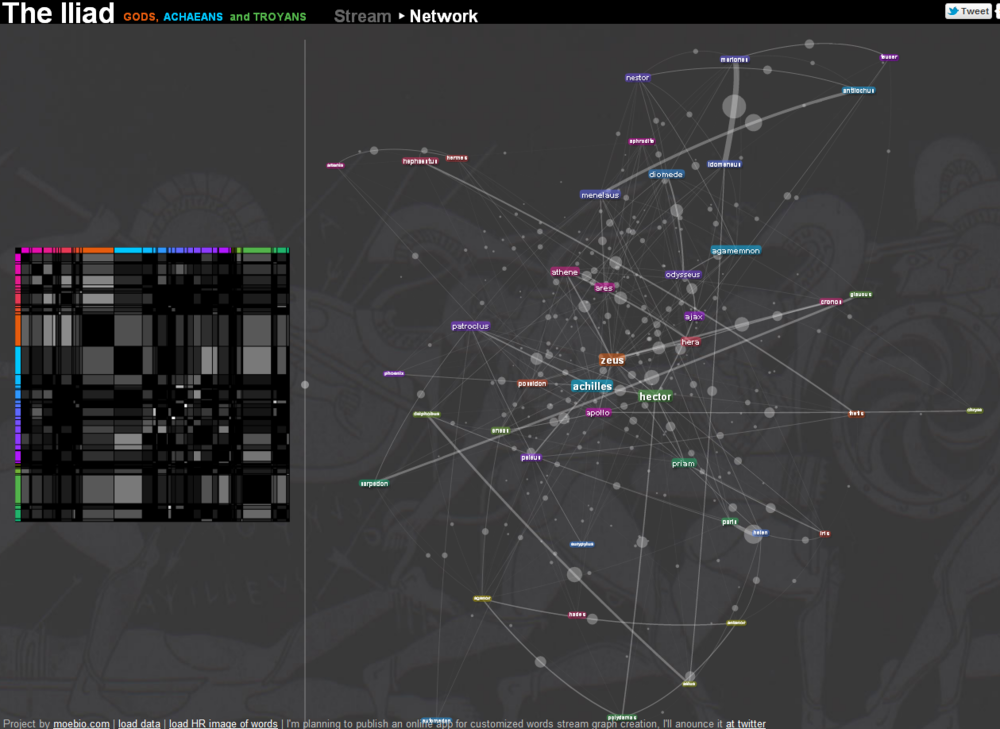
I like the straightforwardness of this translation; I love Jacobi's plummy voice. Now I just need to get a sense of the whole thing, in time to rationally discuss it for a whole day this weekend. I need an Iliad flow chart. Internet, aid me!
Nope, that didn't help.
I like words. I think they should be free to roam in wide open concept barns equipped with nests.
Sunday, December 1, 2013
Sunday, November 24, 2013
How to survive 50 years (if you're a story)
Yesterday, along with literally millions of other people, I watched The Day of the Doctor - the 50th anniversary episode of Doctor Who. The episode was officially the biggest simulcast of a TV drama ever, broadcast simultaneously in 94 countries, on TV and streaming online, and in 1500 movie theatres in 3D, and I lucked into a ticket because a friend of mine had bought two during the approximately 28-minute period that there were any available, before they sold out.
Doctor Who is the longest-running science fiction show of all time, and one of the longest-running television shows, period, of all time (there may be a soap or two that beat it.) The first episode was aired on November 23, 1963, and no one had a clue what they had on their hands. No one involved in the show then would have had any idea that in fifty years, people would be selling out movie theatres, and gathering at their houses to watch on television or online, all over the world. How could they? They were just making a science fiction show for families to watch; something with a bit of an educational bent, catching the SF wave, on a budget, for the BBC.
Today, though, I bet BBC executives are doing happy dances. Doctor Who is probably one of the BBC's biggest exports and cash generators. The revenue generated from this 50th anniversary release must be impressive. What other television show could have fans paying movie theatre prices to watch a special episode? What other television show could cause people to speculate that the Hunger Games sequel might suffer a dip in opening weekend box office because the audiences were busy watching Doctor Who? What did advertisers pay the BBC to be featured on their mini episodes, released online leading up to the special, or to be featured on the big screen before the broadcast?
And - has Doctor Who set a precedent, broken ground in how television gets presented? Is this where "event television" might go? Given the success of this, are we likely to see, say, the series finale of Game of Thrones broadcast to theatres?
I'm a pretty big fan of Doctor Who. I watched it as a kid in the eighties, but not seriously - I remember catching it when I happened to have the TV on and it was playing on the public broadcasting network. I loved it but for some reason never knew quite when it would be on. I remember a few vague scenes, mostly of the Doctor and whichever companion he was with running around through slate quarries - I mean, alien landscapes - being chased by Daleks. I definitely remember the Daleks. I think any kid that saw them does. Today I heard an interview with Peter Davison, the fifth actor to play the Doctor, who confirmed that yes, even in real life when you know they're props, Daleks are unnerving. It's the way they glide.
And I remember that I thought the theme music was creepy, and cool, and strangely sad, all in one. Oh, and that endless looping chrome tunnel that the title credits appeared over was mesmerizing to me. Also, in those years there were writers and actors that cemented the show's future: the years with Tom Baker as the Doctor and Douglas Adams on the writing team are probably responsible for the show's survival to 2013.
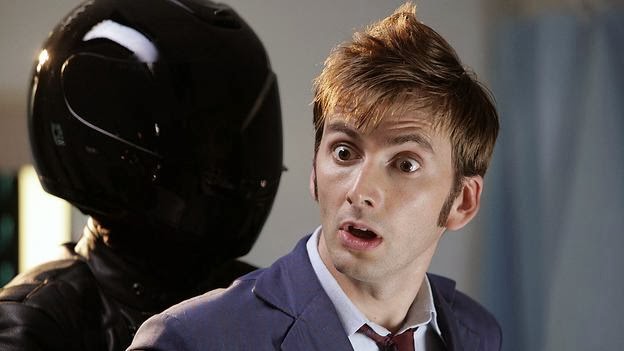
I got back into the show, like a lot of people, with the "new Who." It started up in 2005, but annoyed with reboots and remakes, it took me a while to watch it: I resisted as my friends started getting hooked around me. But I started in around the third season. My first episode, I think, was "Smith and Jones," in which the Doctor's second (well, second in terms of the new series) "companion" is introduced, Dr. Martha Jones. She's in a hospital that gets unexpectedly relocated to the moon. Then invaded by space cops with the heads of talking rhinoceri. Then this frenetic skinny guy with spiky brown hair in a suit and running shoes shows up and, among other things, absorbs a room full of radiation into his body, then expels it into his shoe, kicks the shoe off, and keeps running around barefoot for the rest of the episode, while managing to save everyone. He looked like he might be a member of some British hipster band, and I remember thinking, "This guy? Really? Doctor Who?"
And yes. That guy. Really. Doctor Who. David Tennant (the tenth actor to play the role: there have, as of yesterday, officially been thirteen) hooked me. Then I started collecting the box sets - the first season, with Christopher Eccleston in the role, then the Tennant years, eventually collecting as fast as they came out and watching them on broadcast at the same time. I'd been making sure I caught every week's episode for a while by the time it was Matt Smith's turn in the TARDIS. And I was, by that point, a dedicated, one might say fanatical, Whovian, with a collection of all the extant "20th century" episodes from 1963 to the ill-fated Fox/BBC co-pro movie of 1996, a handful of the audio dramas, and a range of buttons, T-shirts, patches, and toys.
So, we get to why I'm writing about this. One of the things that fascinates me about this show is that it shouldn't survive. It shouldn't be popular. Other blockbuster science fiction shows, like Star Trek, make a lot of hay out of scientific explanations of their gadgets and gizmos. What Trekker doesn't have a blueprint of the Enterprise somewhere, detailing exactly where the kitchens and toilets and turbolifts are? There's a hunger for explanation, for categorization, for everything to be explained, in the geek world. Think of things like Dungeons and Dragons, where everything has a set of statistics.
Doctor Who, in contrast, breezily ignores explanations. What's the inside of the TARDIS look like, other than the main console room where everything happens? Well, it looks like whatever the TARDIS (which, it should be explained, is semi-sentient, sometimes) wants it to. Why does it look like a police phone box on the outside? Because it's broken. (A writer once tried to write some technobabble to explain the shape, back in 1963: it was lame and pseudomystical, and the then show runner, Verity Lambert, chucked it and instead declared that the TARDIS was supposed to change appearance to blend in with the local surroundings as camouflage, but the circuit was stuck. It's stayed stuck for 50 years now. Though now, occasionally, it can be invisible.) Does the Doctor have any special powers or abilities? Only when the plot requires it. Does he need to be clairvoyant, telepathic, a hypnotist, an expert swordsman? He can be, when it's required, but it's not a character point. What does that sonic screwdriver he carries around do? Whatever makes the story more fun. What are its limitations? Ditto.
This kind of rule-chucking flies in the face of almost everything else in science fiction and fantasy. One of the main rules of worldbuilding is that your world and setting and the science and/or magic you use needs to be consistent. Then Doctor Who comes along and tells you that hand-waving isn't a narrative failing, it's the main joy of the show. Although they said in 1964 that the Cybermen came from Earth's hidden sister planet Mondass, they're actually, now, from a parallel universe. And that's okay. And you know how we said Daleks worked on static electricity and so needed to be in contact with a metal floor? They got better. Why doesn't the human race remember about the dozens of times they've been invaded or subjugated or otherwise nearly wiped out? We're thick. Or there was a time paradox thing and we all forgot. Know how the Doctor absorbed all that radiation and said it was child's play? Well, for this story we need him to die of radiation poisoning, so he can't do that anymore. No reason.
This should infuriate the sort of person who wants blueprints of the Enterprise. Instead, they love it. They make up all their own rules and laws to cover all the gaps and inconsistencies. Or, like me, they celebrate the sheer loopiness of it, and look at it this way: Doctor Who is about stories. The main character is a story. Occasionally, he knows it. The show even comments on its own story-ness, at times. (The glee with which the Doctor and his companions often discover that they're in a particularly new story is always fun. In one episode, after narrowly escaping the monster of the week, the Doctor and Rose turn to each other. "I tell you what, though," Rose says, excitedly. "Werewolves!" He answers, "I know!" with a huge how-cool-is-that grin.) One of my personal favorites is when there's a plot point that turns on "stet" radiation: "Never heard of it," the Doctor says. "You wouldn't want to," another character says. Meanwhile, as an editor, I stifle a giggle: "stet" is proofreading notation indicating that an editor's change needs to be reversed: the thing that was eliminated gets restored. The next bit of the plot involves a character who can't die. Maybe it's just an editor thing, but it makes me grin.
Also, the show shouldn't survive because the central protagonist actually changes his entire face and personality on a regular basis. Every so often, the Doctor is killed. And when that happens, he transforms into another man. With the same memories, but a different personality. The first time they did this, when the first Doctor, William Hartnell, was sick and couldn't continue in the role, must have been a leap. It's still a bit strange. But now, it's part of the culture. Those of us that have known the show a long time - I was watching when Tom Baker gave way to Peter Davison in the mid-eighties - get to feel a little smug whenever a changeover happens, and we watch the newer fans mourn the loss of "their" Doctor, and vilify the new one for whatever they see as his faults.
Meanwhile, those of us who have been through a few regenerations have taken it as part of the fandom. Who will the new Doctor be? How will he change the tone? Rumours and speculations about the new actor will fly. We'll watch ourselves go through the phases: mourning the loss of an actor we loved in the role, settling in with the new guy, deciding what we think of him, finding the through lines that let us, mentally, tie him to his predecessors, and, eventually, learning to love some aspect of the way he plays the character. Yesterday, in the theatre, we got a second-long flash-cameo of the upcoming actor, Peter Capaldi (Matt Smith is leaving the role after the Christmas special this year), and there were cheers in the theatre: we're sad to see Smith go, but we're excited to see how the character will change.
Because although the actor changes, the story keeps going. And it can only keep going by being loopy and inconsistent and allowing us to be okay with that. In fact, encouraging us to embrace it. Every time an actor leaves - a Doctor or a companion - you think about the stories that you didn't get to see happen with them, but the story itself is not over. You can go back, if you want to see Tom Baker's bug-eyed strangeness, or Peter Davison's big-brother kindness, or William Hartnell's crusty tetchiness, or Paul McGann's Romantic elegance, or the bottled anger of Christopher Eccleston. They're all still there. You won't get any more stories with them, and that's sad. But you'll get new stories with this new guy, and he'll be great in his own way, and he will, ever so often, also remind you of the past Doctors.
And in that way it's a lot like life.
Thursday, October 24, 2013
Writers Festival kicks off
I just remembered I didn't actually report in about Detroit. Will do: soon.
Tonight I ran to CKCU to do an episode of Literary Landscapes, talking about the upcoming funding drive and the Writers Festival, which just kicked off tonight with a lovely event with Jim Cuddy and Greg Keelor from Blue Rodeo (which I scurried off to after the show was over) - a look back at the creation of the iconic album Five Days in July, with messages and interviews from the musicians who were part of it, conversations about the creation of the songs, and covers performed by various musicians, as well as by Jim and Greg. Very cool.
(It occurred to me, sitting in the overflow room with my friend Terry, that I'm fairly certain I went to a Blue Rodeo concert on what was probably my very first - and therefore pretty awkward - date. Which made the evening a little surreal for a moment or three.)
Anyway. It seems to me that these songwriters' events - curated by Alan Neal from CBC's All in a Day - are a unique beast, and really Writersfest is the only place I can imagine them working. Which they do, marvellously - people do want to hear the stories behind the songs, and hear the songs, and the cross-pollenation that Alan manages to get by inviting - and getting - people like Jully Black and Mike Dubue to, say, come cover some Blue Rodeo tunes on stage means that you're getting a really unique event. Not a concert, not an Inside the Artist's Studio kind of thing; something in between the two, with a kitchen party vibe thrown in too, as the musicians start to relax and jam and play with each other.
The Festival continues tomorrow: I'm taking George Elliott Clarke to a couple of schools, and the evening's packed with coolness, including a launch by David O'Meara, Stephen Brockwell reading from his new book, and the Newlove Awards...
Tonight I ran to CKCU to do an episode of Literary Landscapes, talking about the upcoming funding drive and the Writers Festival, which just kicked off tonight with a lovely event with Jim Cuddy and Greg Keelor from Blue Rodeo (which I scurried off to after the show was over) - a look back at the creation of the iconic album Five Days in July, with messages and interviews from the musicians who were part of it, conversations about the creation of the songs, and covers performed by various musicians, as well as by Jim and Greg. Very cool.
(It occurred to me, sitting in the overflow room with my friend Terry, that I'm fairly certain I went to a Blue Rodeo concert on what was probably my very first - and therefore pretty awkward - date. Which made the evening a little surreal for a moment or three.)
Anyway. It seems to me that these songwriters' events - curated by Alan Neal from CBC's All in a Day - are a unique beast, and really Writersfest is the only place I can imagine them working. Which they do, marvellously - people do want to hear the stories behind the songs, and hear the songs, and the cross-pollenation that Alan manages to get by inviting - and getting - people like Jully Black and Mike Dubue to, say, come cover some Blue Rodeo tunes on stage means that you're getting a really unique event. Not a concert, not an Inside the Artist's Studio kind of thing; something in between the two, with a kitchen party vibe thrown in too, as the musicians start to relax and jam and play with each other.
The Festival continues tomorrow: I'm taking George Elliott Clarke to a couple of schools, and the evening's packed with coolness, including a launch by David O'Meara, Stephen Brockwell reading from his new book, and the Newlove Awards...
Thursday, September 26, 2013
Maybe someday you can go to Detroit.
![]() |
| From the inimitable Uncle Shelby's ABZ. Shel Silverstein is a god. |
It's kind of literary, right? Tomorrow I'm heading out of town in the afternoon with my friend Jex to drive to Detroit for the weekend to see an exhibit of Dr. Seuss's hats. No, really.
I admit it's a pretty random thing to do. But what's life for, if not to do random things with?
I'll report in.
Wednesday, September 25, 2013
Collaborating kick start
The Kymeras' show at CAN*CON (Evelyn: A Time Travel Love Story) is coming up fast. We met up this weekend to run through the first real version of the show and figure out exactly what order things would go in.
I'm in an interesting position in this process. We're expanding a poem of Sean's into a full show. Marie and Ruthanne are filling in details of the narrator's story. I was given pretty much anything to do on my part, and in the first meeting it was suggested I could fill in the other voice - that of the narrator's wife. That way the two "characters" are voiced by poets while the narrative details are done by the storytellers.
But that meant I had to go home and write some poems about a very specific thing, in a very specific voice. It was tricky - I wrote a lot of fragmentary pieces which I then stuck together, or picked up and expanded. My character is only in the story in a strange, sort of disjointed way, so I wound up writing her voice in a series of short journal notes and fragments of letters and thought processes. Her speaking, in her mind, to either her husband or herself. When I brought them to the second meeting I thought I had a bunch of crap. But then we started shaping the story up, and it started to take a form with our four narratives interrupting each other and interweaving. We went off so the storytellers could craft their bits and Sean and I could tinker with our poems. Sean wrote a longer, more satisfying denouement and cut the poem into sections that could be interrupted by story. And I poked at my little poem fragments and couldn't really see how to make them into anything else.
But then this weekend we met again. I still just had my little fragments, and one full poem that I was happy-ish with. But magic happened. As we started the rough runthrough - Sean reading his intro, then Marie walking us through her story framework, and me reading out the poems I thought would go in various places - things started to fall into place. I still only had my fragments for the second half, but while people were reading through their parts I started crossing stuff out, drawing in arrows, reshuffling everything on my page. Between me and Ruthanne - covering most of the second half of the show - we rearranged the stuff I'd written, fit in in between Ruthanne's short vignettes, and suddenly there were all these resonances bouncing around between the different voices and threads of the story. I could actually see how the bits I'd written related to each other, where they could fit together into more coherent wholes.
And suddenly I felt more like writing than I have in a long time. Having some other brains around to bounce things off of, yes, but more importantly, working with those other brains on an actual collaboration got my brain engine rumbling. And I remembered, again, how much I like working with the Kymeras.
Good news, by the way: you can now buy a day pass for Saturday evening at CAN*CON, so you can come for just the evening's shows, including Evelyn.
I'm in an interesting position in this process. We're expanding a poem of Sean's into a full show. Marie and Ruthanne are filling in details of the narrator's story. I was given pretty much anything to do on my part, and in the first meeting it was suggested I could fill in the other voice - that of the narrator's wife. That way the two "characters" are voiced by poets while the narrative details are done by the storytellers.
But that meant I had to go home and write some poems about a very specific thing, in a very specific voice. It was tricky - I wrote a lot of fragmentary pieces which I then stuck together, or picked up and expanded. My character is only in the story in a strange, sort of disjointed way, so I wound up writing her voice in a series of short journal notes and fragments of letters and thought processes. Her speaking, in her mind, to either her husband or herself. When I brought them to the second meeting I thought I had a bunch of crap. But then we started shaping the story up, and it started to take a form with our four narratives interrupting each other and interweaving. We went off so the storytellers could craft their bits and Sean and I could tinker with our poems. Sean wrote a longer, more satisfying denouement and cut the poem into sections that could be interrupted by story. And I poked at my little poem fragments and couldn't really see how to make them into anything else.
But then this weekend we met again. I still just had my little fragments, and one full poem that I was happy-ish with. But magic happened. As we started the rough runthrough - Sean reading his intro, then Marie walking us through her story framework, and me reading out the poems I thought would go in various places - things started to fall into place. I still only had my fragments for the second half, but while people were reading through their parts I started crossing stuff out, drawing in arrows, reshuffling everything on my page. Between me and Ruthanne - covering most of the second half of the show - we rearranged the stuff I'd written, fit in in between Ruthanne's short vignettes, and suddenly there were all these resonances bouncing around between the different voices and threads of the story. I could actually see how the bits I'd written related to each other, where they could fit together into more coherent wholes.
And suddenly I felt more like writing than I have in a long time. Having some other brains around to bounce things off of, yes, but more importantly, working with those other brains on an actual collaboration got my brain engine rumbling. And I remembered, again, how much I like working with the Kymeras.
Good news, by the way: you can now buy a day pass for Saturday evening at CAN*CON, so you can come for just the evening's shows, including Evelyn.
Wednesday, September 18, 2013
Revisiting Watership Down, and some thoughts about stories
A while ago, a friend of mine started "The Most Awesome Book Club Ever": a book club where the idea is to read books that are considered "Great Books" that you might have been asked to read in school but somehow missed. Books you're supposed to have read. Things like War and Peace, or the Odyssey, or The Origin of Species. (Which was our first book, actually. I didn't like it that much.)
I think the characters being simple is a strength, rather than a weakness, in the book. They're already talking rabbits, after all. We're already dealing with a metaphor, or a myth, or an allegory, or something. The subthread about storytelling underpins that. So there's never really much question that Hazel, the leader, is going to be the leader. He's a perfect leader - not particularly strong or clever himself but able to see the skill sets at his disposal and put them together, and also able to read a mood and know how much he can ask of his people. In the same way that you know who Hazel is because you know the "leader" archetype, you also know what to expect of the rest, and it's satisfying when they fill those roles well: Bigwig being tough and loyal and self-sacrificing, Blackberry thinking up the clever plan, Fiver never, ever, once having a bad feeling that turned out just to be a badly digested carrot or something.
This month's book is Watership Down, by Richard Adams. I've read it before: in fact, I grew up with it. I went to see the movie when I was seven: my family was living in Indiana at the time, and I think it was screened at the university there, but I don't really remember - I do remember images from the movie, some of them quite terrifying, and some of them quite beautiful. I think my parents read me the book first, as part of our usual bedtime stories. (My parents read me all kinds of books at bedtime, from Watership Down to The Lord of the Rings to Robinson Crusoe, and if they had scary bits, we dealt with that. In various ways. Depending on the book.) So when I was a kid, I sometimes pretended to be Hazel or Fiver (usually Fiver: I always liked psychic characters) and I had nightmares about the Black Rabbit of Inlé.
And I read it again, this week. I just finished it. Correction: I just finished wiping the tears off my face, after finishing it. How dare a book about rabbits do that to me?
I re-read another of Adams's books recently, The Plague Dogs, because I'd just been to the Lake District, where it's set, and so I had the literary equivalent of an earworm. They're very different books, and for a while I thought I liked The Plague Dogs more. It's certainly more aimed at adults. It's also preachier. Angrier, maybe. In Plague Dogs Adams goes off on long flights of reference, paraphrasing chunks of Shakespeare and Ovid. In part I think it's deliberate: he's echoing the hyper-associative, disjointed internal world of his insane protagonist Snitter, a dog who's undergone brain surgery as part of an experiment. But it has always struck me as a bit self-indulgent. It's a satirical voice, and being satirical can often mean getting self-indulgent. You can read it as Adams being arch and sarcastically angry and having fun with his overblown language, and I did, and I do like The Plague Dogs. But now that I've reread Watership Down, I've revised my best-Richard-Adams book order. Watership wins, hands down.
It's his economy in Watership Down. It's a long book, sure, but because I read it as a kid, it all seemed to take longer (reading is so immersive when you're ten or so). I realized, this time around, that in fact a whole lot happens in a few pages. There's so much detail packed in, neatly, unnoticeably, that it feels longer. The friend that started the book club mentioned, as she was reading it, how information like "human activity causes background noise that disturbs animals" can be delivered almost indetectably by describing the silence of Watership Down, where our heroes establish their new home. Points like "domestication takes something vital away from species that are meant to be wild" are illustrated rather than stated, by the strange, semi-domesticated Cowslip and his warren and the hutch rabbits Hazel frees, who are so inept.
And there's the subthread about storytelling. Alongside Hazel and his group's adventures, there's a counterpoint series of folktales about El-ahrairah, the rabbit trickster hero. To Adams's rabbits, storytelling is a central social glue. Rabbits love a good story, well told, and while it's being told, they live it. They spread news by telling stories - when Captain Holly arrives at Watership Down, having narrowly escaped the destruction of their old warren, they wait until they can all gather and he can tell the story as a story before anyone asks him for details about what happened to him. Then, when he does, all of the rabbits suffer through the same feelings and experiences as he did, and by doing that, they get their grief out and over with. The idea, I think, is that for a species with "a thousand enemies," the best way to learn survival skills is to tell these stories: you can learn from a story without running the risk of being killed by a fox or something.
Tellingly, in the warrens in the book where the rabbits are not living natural lives - in what I call "the Stepford warren" where the rabbits are actually being semidomesticated so they can be trapped for fur and meat, and in totalitarian Efrafa - the rabbits no longer tell stories. Instead, they recite poetry. Instead of sharing an external social narrative, they share an internal, psychological narrative. They turn inward. (But, to be fair to the poets, in both of those warrens, poetry is also an act of subversion, of saying things that are forbidden.)
Adams' rabbits lead an immediate kind of life, where real threats and dangers force them to be clever and fast and strong: he may be hinting that we, as humans, lead a life much more like that of the creatures we domesticate, where our stories don't teach, our art is internal and reflective, and our instincts are dulled. He certainly uses the two dystopian warrens to show us two different outcomes of surrendering your self-determination. In one, luxury stultifies a whole culture: in the other, a dictatorship takes over and imposes a rigid, unnatural way of life.
And yes, the characters are simple. I think of them as the classic adventuring party from a fantasy. You've got your born leader, your staunch and loyal lieutenant, the clever one, the mystic, the storyteller and charmer, a couple of rank and file types, and the one that needs protecting.
I think the characters being simple is a strength, rather than a weakness, in the book. They're already talking rabbits, after all. We're already dealing with a metaphor, or a myth, or an allegory, or something. The subthread about storytelling underpins that. So there's never really much question that Hazel, the leader, is going to be the leader. He's a perfect leader - not particularly strong or clever himself but able to see the skill sets at his disposal and put them together, and also able to read a mood and know how much he can ask of his people. In the same way that you know who Hazel is because you know the "leader" archetype, you also know what to expect of the rest, and it's satisfying when they fill those roles well: Bigwig being tough and loyal and self-sacrificing, Blackberry thinking up the clever plan, Fiver never, ever, once having a bad feeling that turned out just to be a badly digested carrot or something.
By halfway through the book, you can't help seeing that these rabbits we're reading about are living out an El-ahrairah story. They even start reflecting on it themselves. Which brings the whole subtheme of storytelling back around, rather neatly. And in the final pages, when El-ahrairah comes to take Hazel away to join the pantheon of stories. . . well, that's the bit where I had to stop and blink and wipe away the tears. Maybe I'm sentimental, but "our children's children will hear a good story" (as Hazel said to Bigwig), resonates with me. "It matters not if you live one day, so long as your deeds live on after you," is the ancient Irish saying.
I'm looking forward to the conversation when the Most Awesome Book Club Ever gets together to talk about this one. Because I know that alongside talking about the different dystopias and false utopias the rabbits encounter, and the ecological points that are made, and the characterization, and the plot arc, there will be the times when one of us will say, "And there was the bit where Bigwig was standing in the tunnel, saying, 'My Chief Rabbit told me to defend this tunnel, and I will,' and Woundwort's thinking, 'Shit, if he's not the Chief Rabbit, then how big must his Chief Rabbit be?!?'" or something like that. We'll share our favorite bits of the story with each other. We'll tell them again to each other. Because that's what stories do, it's what they're for.
And it had never occurred to me before, but I think that's a big part of what Watership Down is all about.
I'm looking forward to the conversation when the Most Awesome Book Club Ever gets together to talk about this one. Because I know that alongside talking about the different dystopias and false utopias the rabbits encounter, and the ecological points that are made, and the characterization, and the plot arc, there will be the times when one of us will say, "And there was the bit where Bigwig was standing in the tunnel, saying, 'My Chief Rabbit told me to defend this tunnel, and I will,' and Woundwort's thinking, 'Shit, if he's not the Chief Rabbit, then how big must his Chief Rabbit be?!?'" or something like that. We'll share our favorite bits of the story with each other. We'll tell them again to each other. Because that's what stories do, it's what they're for.
And it had never occurred to me before, but I think that's a big part of what Watership Down is all about.
Tuesday, September 17, 2013
Not being at all nice in a review, which is possibly a first for me.
I suppose it was inevitable.
I got bored this afternoon. And I've just discovered readanybook.com, where you can read a bunch of books online if you're not picky about format. And because I was bored I read the first page of the first book presented to me, which happened to be Twilight. Hey, I had to look. And I thought, okay. Maybe I should see what all the fuss was about. Expectations not high, but if I'm going to denounce a thing, I suppose I should at least have read it.
I tried, I really did, because goddamn it there has to be some reason so many people were so crazy about this book . . . but about a third of the way through it I just couldn't take any more.
It really is as godawful as people say. It is unspeakable. How in the name of all that is holy was this a bestseller?
Not only that, it really is poisonous in terms of what it says to young women about what's desirable in a man. Every single thing about Edward and how he treats and reacts to Bella should be sending off a million alarm bells screaming this guy is a psycho stalker, potential abuser, control freak with anger issues, big woop woop woop alarm klaxons going off avoid avoid avoid. Anyone - "perfect," "alabaster," "flawless," or not - who behaved like this around any rational female would instantly get filed under "keep-911-on-speed-dial." Even in high school. But no. She's irrevocably in love with him, pretty much immediately, because... he's perfect. A fact of which we're reminded about three times a page (note the above references to "perfect alabaster flawlessness").
So, in fact, every single thing about Bella also sends off huge alarm bells for me. She's a painful Mary Sue. She has no internal life outside of Edward, and even that is unconvincing. She doesn't act like a teenager, or like an actual human being for that matter. And apparently thinking it's hot to be terrified of someone (who's a perfect alabaster sparkly god who wants to kill you but that's totally okay because, you know, he's perfect) isn't a sign of any deepseated personality disorders at all.
On top of all that the writing is tooth-achingly dull and plodding.
Augh. AUGH. I have to go bleach my brain now.
I got bored this afternoon. And I've just discovered readanybook.com, where you can read a bunch of books online if you're not picky about format. And because I was bored I read the first page of the first book presented to me, which happened to be Twilight. Hey, I had to look. And I thought, okay. Maybe I should see what all the fuss was about. Expectations not high, but if I'm going to denounce a thing, I suppose I should at least have read it.
I tried, I really did, because goddamn it there has to be some reason so many people were so crazy about this book . . . but about a third of the way through it I just couldn't take any more.
It really is as godawful as people say. It is unspeakable. How in the name of all that is holy was this a bestseller?
Not only that, it really is poisonous in terms of what it says to young women about what's desirable in a man. Every single thing about Edward and how he treats and reacts to Bella should be sending off a million alarm bells screaming this guy is a psycho stalker, potential abuser, control freak with anger issues, big woop woop woop alarm klaxons going off avoid avoid avoid. Anyone - "perfect," "alabaster," "flawless," or not - who behaved like this around any rational female would instantly get filed under "keep-911-on-speed-dial." Even in high school. But no. She's irrevocably in love with him, pretty much immediately, because... he's perfect. A fact of which we're reminded about three times a page (note the above references to "perfect alabaster flawlessness").
So, in fact, every single thing about Bella also sends off huge alarm bells for me. She's a painful Mary Sue. She has no internal life outside of Edward, and even that is unconvincing. She doesn't act like a teenager, or like an actual human being for that matter. And apparently thinking it's hot to be terrified of someone (who's a perfect alabaster sparkly god who wants to kill you but that's totally okay because, you know, he's perfect) isn't a sign of any deepseated personality disorders at all.
On top of all that the writing is tooth-achingly dull and plodding.
Augh. AUGH. I have to go bleach my brain now.
Subscribe to:
Posts (Atom)