Monday, June 12, 2023

Turning waste meaning into energy: Babel, by R. F. Kuang

I have just come across what might be the most interesting magic system in a fantasy book that I have ever seen, and I need to rave about it. 

I discovered Babel: Or the Necessity of Violence: An Arcane History of the Oxford Translators' Revolution, by R.F. Kuang, because of an episode of Lingthusiasm, the linguistics podcast co-hosted by Gretchen McCulloch and Lauren Gawne. They've had a couple of episodes where they talk about linguistics in fiction, often wandering into fantasy and science fiction because, yeah, those genres have a vast scope to play around with when it comes to thinking about language. Anyway, in this episode they described this system, and I almost immediately went looking for the book. 

It's set in an alternate 1830s England. The magic is based on translation, etymology, semantics and possibly also semiotics, unless I really don't get what semiotics is (a strong possibility). How it works is deceptively simple and concrete for a magic system. It's done using bars of silver. On one side of the bar, you write a word or phrase in one language. On the other, you write a translation of that word or phrase in a different language. Sometimes the words are cognates or calques or loanwords, sometimes they're translations of the same meaning but not related to each other historically. The silver catches what is lost in translation and amplifies it. You can't be sure what the effect of any pair will be, but once you've discovered a pair that creates a useful effect, it can be applied over and over. 

The first example you encounter in the story is a bar with the pair "triacle" and "treacle." "Treacle" in English means molasses. "Triacle" comes out of French but, well, ahem: 

From Middle English triacle, partly from Old French triacle, and partly from Old English tiriaca, both from Late Latin *triaca, *tiriaca, late form of theriaca, ultimately from Ancient Greek θηριακή (thēriakḗ, “antidote”), feminine form of θηριακός (thēriakós, “concerning venomous beasts”), from θήρ (thḗr, “beast”). Compare theriac, theriacle.

"Triacle" is an antidote, made sweet to make it easier to take. "Treacle" is just the sugar. The silver bar catches the difference in meaning, the idea of "antidote" that has been stripped from the English "treacle," amplifies that. . . and cures the main character of cholera. 

The other catch is that you can only make the effect happen by speaking the two words out loud, and you have to speak both languages fluently, so fluently that you understand the resonances of the differences in meaning. You probably have to understand both languages better than most speakers of either. If you're the sort of person that believes the "port out, starboard home" etymology, you probably can't make the bars work. And if you can make an English-Hindi pair work, that doesn't mean you can make a Hindi-Tagalog bar work.

And the greater the difference in the languages, the less history the languages have in common - the more difficult they are to translate - the more powerful the reaction. 

The silver bars, in this alternate world, have taken the place of the Industrial Revolution in ours. Which means that the British Empire functions based on "silverworking." And it means that as the empire expands, its hunger for increasingly foreign languages and cultures grows - especially since as British hegemony spreads, other cultures become less distinct. The differences between them erode away. So the magic system is also intertwined with the plot, as the main characters, brought from outside cultures - China, India, Haiti - are brought to Oxford to study languages and make the magical silver bars that power the empire that is slowly taking over their motherlands. And as they slowly realize that England is taking all of their cultural diversity for itself, to make its trains run more smoothly, its gaslights burn more reliably, and its dinner parties more lavish. And that the more people they have that speak, say, Mandarin, the more useful Mandarin is, while there's no point to researching English/Yolngu Matha match-pairs, because how many people will ever speak both languages? 

So the magic system also implies a slow erosion of the lesser-spoken languages because they are not "useable" to the empire, even as that means it's giving up the power of the vast diversity of those languages. Urdu is something the empire can reasonably use. Kanienʼkéha isn't. 

The anticolonial message is a little heavyhanded but in order to get to the - let's face it, the subtitle is "the necessity of violence" - tragic and violent ending, it sort of has to be. The characters are driven by the kinds of social theories that have driven revolutionaries to strikes and barricades and incarceration and execution forever. But they're also driven by a shared love of digging through textbooks looking for the laws of speaking and meaning, they rebel while also thinking about what it really means to understand another person and whether it's possible. The implications of language and translation are less didactic in this book, and lingered in my mind longer, than the obvious "white supremacy and imperialism is a bad thing" theme. 

I think what I really loved about this magic system was how constrained it was, the way it was rooted in something I've never seen used as a source of power before - capturing waste meaning like waste energy in a reactor - and the way the mechanics of its functioning mirrored and served the ideological proposition of the story. I don't think I've seen anything like it before. 

Sunday, March 1, 2015

Grokking Spock

Here's the thing: I know that Leonard Nimoy has, in the past, had a slightly strained relationship at times with Mister Spock. I can't imagine what it would be like to be known, forever and unshakeably, for a part you played for three years in the sixties (and then again in several movies, and last, in your eighties, in the reboot of the franchise, as the older, alternate universe version of the new guy). I think of Alan Rickman's "Dr. Lazarus" in Galaxy Quest, forever doomed to show up in prosthetics and say "By Grabthar's hammer, you shall be avenged." After Star Trek, Nimoy was Spock, despite his directorial, songwriting, poetic and photographic achievements.

And when Nimoy died on Friday, he was mourned as Spock. There was a huge online wave of people, including me, posting our farewells with the Vulcan salute and the hashtag #LLAP (Live long and prosper). He was - and always shall be - our friend.


I thought about it before I posted that picture, knowing that, in some ways, that hand sign is Grabthar's hammer.

But I had reasons. For one thing, that hand sign and everything it represents may not really be about Leonard Nimoy the actor and director and artist. But it is the most visible signal and sign for Star Trek. Nimoy played, and helped to shape, a character who was more than just a stereotypical sixties SF alien. Spock had dignity and character and nuance. When I was a kid and the neighbourhood children played "space explorers," Spock was my role model, and I think he was for a lot of people. Kirk might have been the swashbuckler, but there was something about the way Spock represented the equal strength of science and order and knowledge and curiosity. And he had a certain tolerant, if a bit exasperated, sense of humour about humans and how illogical they could be. He was a critical lens through which you could look at humanity and, forgivingly, recognize how much more growing up our species has to do.

He also, as I learned on Friday as people wrote posts and comments, served as a role model for a lot of kids struggling with their identities - either because they were mixed-race, like Spock, or were having trouble dealing with their emotions, or felt they didn't fit in because they were quiet or nerdy or whatever. In the same way that Lt. Uhura was there for black kids, Spock was there for the geeks and freaks and outsiders.

Star Trek did many things that were not just groundbreaking, but inspiring. It told women and minorities that there was a place for them on the bridge, in the future. It said that human beings could get better, and eventually get over things like greed and violence and hatred, and use our skills for exploration and discovery. All that stuff. All the reasons that fans love the show.

And a couple of generations of future actual space explorers were watching, and listening.

We live in a world where young women go to work on the International Space Station, and they bring Starfleet comm badges.

1967: launch of Mariner V.
NASA techs in paper Spock ears.
People in the space program today grew up with Star Trek as part of their cultural story about exploration, and about science and discovery, and about what they have to do with being human. If you buy into Star Trek, you buy into the drive to discover what's out there. In the version of human history where we get better and keep exploring and striving and learning and being excited about our universe, Star Trek is part of the myth. And there's that salute, and therefore that character, to encapsulate it.

So when I posted my #LLAP picture, along with a lot of other people around the world, yes, I was mourning the loss of Leonard Nimoy - not because of what he'd done outside of Star Trek, although he did do some great things, but because he was Spock and Spock is the most obvious symbol for Trek, and Trek is a symbol for wanting better things from the human race.

It was a way of recognizing just how much our shared myth about what humans can be is owed to a story, one so familiar to us - even to the ones that aren't the freaks and geeks and outsiders, now - that I can put up my hand, and split my fingers, like that, and say volumes without saying a word.

Live long, and prosper. Peace and long life.

Wednesday, November 26, 2014

On making it up as you go along

As NaNo draws to a close, I realize I haven't done nearly as much writing this month as I'd like to have done. But I did get to have a great conversation with improv actor and storyteller Dave Morris, from Paper Street Theatre, on Literary Landscapes, about the stuff that goes on when, as during November, people stare at a blank page and then force themselves to write things on it. Because Dave (and the rest of Paper Street Theatre) goes one better than that - he makes it all up on stage, in front of an audience, when blanking on what comes next doesn't involve getting up for another cup of tea, or checking Twitter. . .  it means silence while a room full of people wait for you to come up with the next thing.

It started when I went to see Paper Street's The Horror Within, put on in Ottawa by the (un)told storytelling series: three members of the troupe improvising stories in the style of H.P. Lovecraft. As a fan of the Great Elder Gods and the literature around them, I just had to go.

For the first half of the show, the three of them got suggestions from the audience - a place, an object, a job, something that might work in a Lovecraftian setting (they were handed a haberdasher, an ocean liner, and a magnifying glass) - and each of them took one of those things and started telling a story that would incorporate it. The three stories were essentially independent, but when the first speaker looked like the line of his first idea might have guttered out, the next would jump in with their story, and so on. Occasionally one person would interact with someone else's story - add a sound effect, or a voice, or act out a part - but the three stories stayed distinct. They also all picked up pace more or less simultaneously, and the segments each person told got shorter and shorter, until they all got to their climactic scenes.

When someone had talked themselves into a corner, the others would step in: when someone had made an error that had struck the audience as particularly funny, they'd work it in as a running gag, and when the actor couldn't think of yet another ornate, flowery synonym (man, does Lovecraft love his synonyms), the audience was with them when they finally gave up and said, ". . . thingy." The audience, I realized, was a part of the performance even more so, maybe, than scripted theatre, because the audience was with the performers. The audience knew they were making it up. The audience was okay with a couple of failed descriptions or moments of awkwardness.

For the second half, they got a suggestion for a title from the audience - my friend Jessica, who had never read any Lovecraft before and knew very little about his work, suggested the one they eventually went with, and won a Cthulhu plushie for it! - and then they created a more interactive, theatrical story, though still with a narrator figure (Dave, in our conversation on the radio, said that they'd found a narrator figure was essential to a Lovecraftian feel).

Anyway, coming out of that I realized I wanted to talk to them about a couple of things: how do they pick out the specific elements that characterize a writer and recreate them in improv? How do they prepare and deal with the moments when the ideas blank out, up there in front of an audience? What kinds of things can writers, who also have to just keep making stuff up if they want to get anything done, learn from the practice of improv?

So I got in touch with Dave Morris, and he agreed to come on the show, and this is what happened.

(Click to listen to the show, on CKCU On Demand.)


Monday, September 22, 2014

I finally get back to (un)told

Maybe it's because it's fall: I'm suddenly itching to go out and do things and see shows. And so I was pretty happy that I could finally, for the first time in a few months, get out to (un)told tonight.

The open mike storytelling series has moved: they're now in the Black Rose room of the Heart and Crown on Clarence. Or, to be more clear - that pub in the Market that is really a whole bunch of interconnected pubs where you're never really sure, once you've gone in, which one you're in? Go round to the back of that (the Murray Street side) and look for the little door next to the Black Rose. Or, wander inside, past miles of oak rails and tiled floors, till you see this:

 . . .and then go down the stairs. 

The room feels nicely packed with thirty people, it's cosy, and pretty quiet, because of the stairs.

The format is still pretty much the same - open mike, you can sign up in advance online at the website or, presumably, talk to Liz when you get there - and they still do the thing where they hand out little slips of paper so the audience can share their own stories on the theme of the day, in a smaller, possibly tweet-able format. (The stories from the slips are read out periodically, giving the writer a small taste of how the tellers feel: a clever move, I think.) Tonight's theme was "Fight or Flight."

And the audience is interesting. Definitely a younger crowd than you see at some other storytelling shows in the city. This was a twentysomething crowd for the most part (not everyone though), and tonight, I'd argue, predominantly male (another oddity: many other storytelling shows skew heavily to women. Then again, that might have just been the way it played out tonight.)

But, the stories!

Some memorable lines, and some impressions:

"'It's a fetish,' was the first thing he said." A woman waiting for a streetcar in Toronto gets approached by a guy who explains he just wants her to kick him in the balls. After making sure he's serious, and won't sue her or anything, she decides, well, she's got nothing else to do till the bus comes. . . this winds up spiraling into a strange sidewalk domination session, to which she remains a completely bemused party. Until the bus comes, and he asks for her number, when she says, "no, are you nuts?"

". . . the Grand Canyon, the vast space between a mother and child. . . " The fight: in a dreamscape campground, two momma bears face off over the same child, through a car windshield. The flight: across America's west.

"I have to confess, I've never really been a fan of outdoor sex." Stuck on a tiny island with your wife when a storm makes your northern Quebec lake impassable? Found a nice, comfy bit of flat stone where you could have a little adult fun? Then suddenly aware of a motorboat approaching, carrying two sketchy guys in camo and hunting gear? Convinced for some reason they're here to take your wife? All you have is a Swiss Army knife? What do you do? What do you do?

"So I turned the gas up to maximum and I walked away from that shit." Bad enough that the mouse crawled out of the barbecue when he fired it up for the first time. But to think it might have had a nest in there . . . and little mouse babies . . . when he turned on the gas . . . well, it had been on full blast for twenty minutes by the time he manned up and went back out there, so if anything was left of the mouse babies, it was only their souls that got into the burgers.

"I was going to die. They were all going to die. I closed my eyes and I could see her. Her lips. The smell of her hair. The feel of her body pressed against mine. And the train was still coming." . . . and you thought this was going to be a love story? This was a story with a first kiss, a remote town, young love, and a terrible storm that took out the train bridge. . . and a barreling passenger train heading for the loose rails over the river. . . and the best "gotcha" tall tale ending I've heard in a long while.

"If someone asks you where you live, don't give them a fucking address. Point right here, at your frontal lobes, and tell them 'Right here, and right now,' because that's all you've got." A raw, emotional account of living through a family member suddenly having a medical crisis and winding up in a vegetative state, and why that means you have to live, and you have to laugh. Also included a badass, tough-as-nails smoke jumper who was (almost) too shaken by grief to dig his wife's grave. And a couple of moments where the teller stopped and said to us, yeah, yeah, it's okay, you can laugh, it's funny, this is how life is. This is how death is. And it's kind of ludicrous.

"She turned around to her assistant and said, 'He has to do this! He has to do this! He has to do this! He has to do this!' She said it four times." All DJ was trying to do was vote. And it ended up with her walking in circles in the polling station, trying to calm down, because despite a driver's license and health card and birth certificate that all said she was female, the woman at the polling station was certain she was male. Was it her voice? Does she have 'one of those faces'? When just voting is a fight-or-flight situation, when "proving you're a person" and that you exist is even harder, how do you cope with it?

It looked to me, coming in after a couple of months off (and, I think, as my first time at (un)told as a non-teller) as though the series is going gangbusters. And it's doing some interesting things. A lot of the people who got up to tell were taking some big risks - not just in being emotionally invested, but in the ways they chose to tell. They banked on the audience coming with them, and most of the time, I think, the audience did. Even to some kind of painful places. It was a good night, with hushed moments and laughs trading spaces.

Tuesday, August 5, 2014

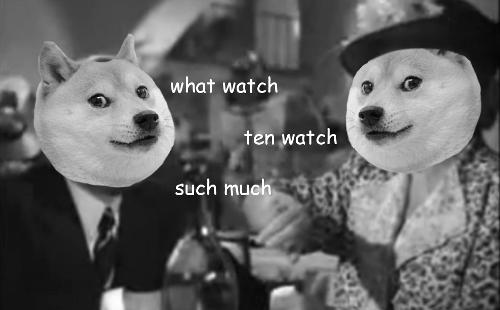
Linguistics geek meets doge

I follow Michael Quinion's World Wide Words newsletter, and he just summed up the Internet meme/fad "doge" (which I have been wanting to do) WAY better than me. I post it here for the edification and amusement of meme-followers and word geeks alike.

---

Such odd. Much cute. So passing fad. The internet phenomenon of doge has been fashionable for some months now and has attracted the interest of linguists. It originally tagged pictures of the Japanese dog breed shiba inu (in multicoloured Comic Sans font), so the name is a deliberate misspelling of dog (no link with the one-time ruler of Venice; don’t ask how it’s said as wars have been started over less and the consensus seems to be “any way you want”). Doge pairs a modifier and a noun to create a dissonant phrase. The main doge modifiers are much, many, so, very, such, plus three words that can be used by themselves: wow, amaze and excite. Typical phrases are very eat, much grumpy, so trick, which usually have meaning only when written on a photo. But I found a retelling of Shakespeare’s Romeo and Juliet in doge, which begins:

What light. So breaks. Such east. Very sun. Wow, Juliet.
What Romeo. Such why. Very rose. Still rose.
Very balcony. Such climb.
Much love. So propose. Wow, marriage.

What interests linguists is that it’s much more than just bad English. It has a strict grammar that deliberately subverts the standard one. You have to have a sophisticated intuitive understanding of English to write good doge. A newbie user wrote “Much respect. So noble” and was immediately corrected because it was too conventional — it should be “Much noble. So respect.” An article in the Daily Telegraph in February was headlined, “Doge: such grammar. Very rules. Most linguistics. Wow”, which pretty much sums it up."

---

I think that last line should be "so grammar. very rules. most linguistics. wow" - lack of capitalization included - but hey, it was the Daily Telegraph and I bet the editor wouldn't let them do that.

Doge fascinates me because it was so obvious that there were rules and grammar to it, which were unofficially, somehow, agreed upon (and argued about as though they were actual grammar) by people who learned the meme and learned to use it. Doge utterly baffles and confuses anyone who isn't in on the joke, but it doesn't take long to get in on the joke - just see a few doge pictures. Then reconstruct the general rules of the meme. To write good doge, the modifier has to disagree with the noun to the greatest extent possible. It has to be the opposite of the right word. Which is why I'd argue that "so grammar" is better than "such grammar." I can imagine using the words "such grammar" together in actual English. Hence, =/= doge. Though, I could be wrong: and of course, the rules of doge don't actually exist except as some sort of collective understanding between total strangers on the internet.


Lots of memes work like this - the Batman/Robin slap meme, the Boromir "one does not simply" meme. You know, after a few examples, where the text breaks, what sort of font to use (the meme generation sites that have sprung up do dictate some of those fonts: but one seems to emerge as the winner, making others look clumsy and amateurish, as though the user doesn't really know the language of the meme). And some are better written than others. Some are plain dumb. Some are created as in jokes for groups so small that the joke is lost on everyone else. But the successful ones can be really clever, and often pick up some universal frustration that a large number of people are feeling.


Doge, though, is a different breed (no, not shiba inu). Doge - a lot like its grandparent, lolspeak - is a language game. Part of the in joke with doge is "I know how to do this." Beyond "I know how to do this" is "I know how to do this and be clever with it." 

On a picture I posted on Facebook of me rock climbing into the sun, stopping to shade my eyes, I commented simply, "very sun. so squint. wow." That's just demonstrating that I know doge and I can do it passably, and fishing for a 'like' from someone else who's in on the joke. It's when you can do something like this, where the reader/viewer can be in on two completely different in jokes, and you've done something clever with the linguistic rules of doge (say, by finding an example of something that looks a hell of a lot like doge from long before the internet existed): then you've reached doge mastery. IMHO. 


Friday, June 20, 2014

A midsummer vignette

Walking down the canal tonight, Byron and I approached a group of teenagers hanging out on the park benches, singing "Barrett's Privateers." Well, trying to. They were bawling out the chorus at least, but then I heard them stumble: "What was the ship's name?" 

"I dunno. . ."

"Well, the something sloop was a sickening sight - "

And they all sang out "HOW I WISH I WAS IN SHERBROOKE NOW!"

And just as they all faltered and fell back into silence, we walked through the group. Without breaking stride, I said, "She'd a list to the port and her sails in rags and the cook in the scuppers with the staggers and jags."

They all stared, then burst into cheers and applause. One held up a hand and gave me a high five as I kept walking, and they all started singing, 

"GOD DAMN THEM ALL. . . I WAS TOLD WE'D CRUISE THE SEAS FOR AMERICAN GOLD. . ." 

I was a few feet away when they finished the chorus and dissolved back into laughter. One shouted "That was AWESOME!" and another yelled something like "Bless you!"

I raised a hand without looking back, like the hero walking off into the sunset, and remarked to Byron, "You know, if I've learned one thing in life, it's that knowing all the words to 'Barrett's Privateers' opens all kinds of social doors." 


Thursday, June 12, 2014

The final hours

I meant to post so much more about the Iliad and the process of working on it for this show, but, of course, life got in the way, and when I would get a moment I could post, I'd realize I could either post about the Iliad - or rehearse for it. And so it goes.

But now, we're 36 hours away, as I write this, from the first voice being raised on the stage at the National Arts Centre, and the beginning of the story.

I will be there in the audience at the beginning, and all the way up to my set, and beyond it. Nervously, and excitedly, waiting for my chance to pick up the story and carry it along, and watching to see the audience getting carried along with it. Watching some of them - maybe most of them - discover or rediscover it. And I will have a completely new perspective on the Iliad from when I started.

You want to know why it's lasted almost three thousand years? We fight wars, the human race. We're cursed with it, maybe. And in our wars, we can be at our most terrible and our most beautiful, our most tragic and our most triumphant. There are moments when people shine - and not necessarily when they fight: sometimes it's when they care for each other, or miss their families, or run back to tend the wounded. And there are moments when one fatal misjudgment can get you killed, or where a man stands shoulder to shoulder with a friend.

Spend as long as we have spent with it (as we, the tellers, have learned to know these people, talked to each other about them, thought about destiny and the patterns and parallels that keep emerging) and I think you'll come to the realization that the genius of the Iliad is that there are no sides, there are no easy answers, there's no "just war" or right side.

Or come spend twelve hours with us, and with it, and with all its complicated, courageous, petty, gentle, loving, frightened, monstrous, valiant, blazing human beings (and gods). I'm sure you'll never forget the experience: and I believe it will speak to you, about the sorrow and beauty of being human. It did to me.


Monday, May 26, 2014

What the Iliad has to do with Chris Hadfield

A couple of weeks ago, I got together with my setmate for the Iliad, Catherine Sheehan, and our "assistant director" Tom Lips, for a sightly belated team rehearsal/coaching session. Each group in a set has an AD who's helping out with some of the coaching so it's not all on Jan and Jennifer to get us to our best performances.

I meant to blog more about the whole process of learning my part of the Iliad, but you know how time goes. But I'd been feeling a looming sense of . . . unease . . . about my memorization process. Namely, that I hadn't really been working on it. But I decided something had to be done when the recurring dreams kicked in (the kind where you're rinkside at the Olympics, about to compete for Canada in pairs ice dancing with your friend Terry, and realize that you don't have a routine worked out, and you can't exactly wing it without finding Terry and talking it over first, and you can't find Terry anywhere, and the Russian team is already out there on the ice: not that I'm thinking of a specific dream here).

Anyway, my subconscious said, loudly, "FFS, Kate, get your crap together and memorize your stuff! What would Chris Hadfield do?"

(Yes. Really. He has a great chapter in his memoir about he doesn't really feel fear because he knows he is prepared for absolutely anything. How you never have to be anxious if you are really, truly prepared. And knowing how deathly nervous I'm going to be on June 14, I cling to that advice.)

So, I buckled down. There was a godsend of a night when I was babysitting my friends' son, and after I got him down for the night I walked around their living room learning the whole segment where the gods enter the fray and things get seriously fantastical. The success of that was encouraging. The second half (all the hand-to-hand combat) I managed by combining cardio workouts and memorization. I'd jump on the machine, put the binder I keep my script in on the console, and then start running, reading, looking away, repeating, then reading, looking away, repeating. . . Meant I could work on memorizing in convenient 30-minute or hour-long chunks, and I was getting some exercise too. Although I bet I was getting some weird looks from the other gym patrons.

I'm glad I memorize quickly. Within about a week, I could sit down, every night, before I switched out of "work" mode and into "wind down" mode, close my eyes, and say the whole 25-minute piece from beginning to end. So when I got to Tom's house to rehearse, I was pretty sure I could rattle it off. Though I wasn't so sure I wouldn't just be rattling.

I don't think I was. There were spots I thought I could put a little more into, but for the first time telling the whole thing in front of a human audience (my cats are another matter) I did okay. The words were all there (except one word, "astonishing," which blocked me every time, and which I have now changed, just to get it out of my way).

And when it came time to hit the all weekend rehearsal last weekend, I sort of got it, what Hadfield means, because as my time to tell started to loom, I was nervous, but mostly just excited to get going. To step up and take my part of the story forward, as one voice in the chain of voices taking us through. I felt like I knew my words and now it was just a matter of doing.

Tuesday, April 15, 2014

Tuesday, February 11, 2014

Shaping a story: an anatomy

This evening I told at the Ottawa StoryTellers' Stories and Tea series. I told a Norse story I was calling "The Giants' Contest" and another storyteller, Mary Wiggin, told a Japanese folk tale called "Three Strong Women."

Afterward, a few people came up to me and asked me things about where my story came from, and how I had adapted it. It wasn't a particularly common or familiar Norse legend, so I even had people asking if I'd written it (although, what does that mean in the context of telling a legend? I suppose the words were mine, but what happened in the story wasn't, at least mostly not: see, it's complicated).

So I thought I'd write about where I got that story, and something about what I did with it before finally standing up to tell it tonight.

It began when Mary and I met a while back, to talk about what we were going to do at tonight's show. At the time I didn't really know what I wanted to tell: I knew that the theme was folk tales, and I haven't really dealt with that material much. So Mary told me about her story, "Three Strong Women," which is about a sumo wrestler, Forever Mountain, who winds up training with a family of three women who are strong enough to carry cows around and throw entire trees.

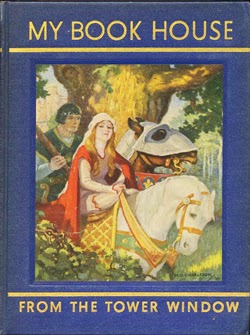
As she was telling me about the grandmother who wrestles with Forever Mountain as a training exercise, I suddenly remembered a story I loved as a child. It was in a collection of twelve books, the My Book House Books, which had belonged to my mother when she was a child. They were first published in 1920, although I think my mother's set was from 1937. The collection started with a volume of nursery rhymes and poems for little children, and then each successive volume aimed at a higher age group and reading level, until somewhere in the middle was a volume of myths and fairytales from around the world. In that volume, there was a story that I still remembered, at least in part: a story in which the Norse thunder god, Thor, finds himself in a castle full of giants. There was a drinking horn that he couldn't finish, and a cat he couldn't lift off the floor, and an old woman who defeated him in a wrestling match.

I mentioned it to Mary, and she said she thought it would work well for the show. So then I had to go home and try to find the story (I don't have the Book House Books, they're at my parents' place).

The Internet is awesome. After a quick search, I found where the story had originally appeared: in the Gylfaginning, the first section of the Prose Edda, written (or compiled) in Iceland, sometime in the early 13th century, by Snorri Sturluson. So then I went looking for the full text (which is here.)

The Gylfaginning is long, and the story is only a short(ish) section, but it wasn't hard to find with a skim. I was looking for Thor, after all, and there he was:

"Then spake Gangleri: 'A good ship is Skídbladnir, but very great magic must have been used upon it before it got to be so fashioned. Has Thor never experienced such a thing, that he has found in his path somewhat so mighty or so powerful that it has overmatched him through strength of magic?' Then said Hárr: 'Few men, I ween, are able to tell of this; yet many a thing has seemed to him hard to overcome. Though there may have been something so powerful or strong that Thor might not have succeeded in winning the victory, yet it is not necessary to speak of it; because there are many examples to prove, and because all are bound to believe, that Thor is mightiest.'"

And after this came the story, about the giants and the contest. And it started with another short bit that I had remembered, without remembering that it was in the same tale: a story where Thor and Loki, staying at a farmer's house, slaughter Thor's goats and eat them, and then Thor revives them in the morning, only to discover that the farmer's son, Thjálfi, had cut open one of the leg bones and sucked out the marrow, so that one of the goats is lame. In fear for their lives, the farmer and his wife give Thor the son and his sister Röskva as servants.


I printed out the section that told the story - the goats, and then Thor encountering a giant named Skrýmir, and the contest in the castle named Útgardr. But you can tell from the segment above that the story was full of "thees" and "thous," and there was no way I was going to tell it like that.

So I took the printout of the story - about five or six pages - and went through a process of reading one chunk of the action, then looking up and saying it out loud to myself, with slightly elevated language but without the extreme archaisms. I would do that a few times, until I thought I had a way of saying what happened that caught the details but didn't sound like this:

"Thereupon Skrýmir slept and snored hard, and Thor took the provision-bag and set about to unloose it; but such things must be told as will seem incredible: he got no knot loosened and no thong-end stirred, so as to be looser than before. When he saw that this work might not avail, then he became angered, gripped the hammer Mjöllnir in both hands, and strode with great strides to that place where Skrýmir lay, and smote him in the head."

Instead, I would say something like:

"And Skrýmir rolled over and went to sleep. Thor went to the provision-bag, but something very strange happened: no matter what he did, he couldn't get the knots open. They seemed simple enough, but no matter how he tugged and pushed and pulled, not a thong would budge. He even tried cutting it, but nothing worked. And realizing that he must have been tricked somehow by the giant, he grabbed his hammer, went up to where Skrýmir lay sleeping, swung the hammer up and brought it down as hard as he could on the giant's head."

I spent at least one night - very late at night, actually; I think it was about two or three in the morning - walking around my living room doing this. After an hour or two, I had the whole thing reworked in my head into my own words, and I went back to bed.

After that, I turned the story over a little in my head, and retold it out loud to myself a few times. I had initially tried to include, in my introduction of Thor, the bit from earlier in the Gylfaginning about his three marvelous items: the hammer, the iron gloves, and the belt that confers his strength. (I also thought I might include the names of his goats: Tooth-Gnasher and Tooth-Gritter.) But then I cut that: everyone knows Mjöllnir, and the other items aren't important.

And I thought about where I could get away with adding lines. Where I could add a line to get a laugh, for one thing, or to create a through line of Thor getting increasingly angry and frustrated as he loses contest after contest. But also, there were things I couldn't explain using only the words in the story: why on earth would Thor agree to travel with a giant, for example? So I put in lines, knowing what I knew about Thor, to explain that.

I also put in some dialogue for Loki, in part because otherwise he's only there to get into an eating contest with the personification of Wildfire, and in part because people are familiar with the Tom Hiddleston/Marvel Loki, who is a lot of fun, and I wanted to give this Loki some character too. Mostly, what I put in was variations on "I told you so, Thor."

I wanted to keep the question-and-answer stuff, where Gangleri asks about Thor and gets hedged answers, and then finally the story of the time Thor encountered something that he couldn't defeat. So I made sure there was a line in my intro that alluded to this exchange:

"Then spake Jafnhárr: 'We have heard say concerning some matters which seem to us incredible, but here sits one near at hand who will know how to tell true tidings of this. Therefore thou must believe that he will not lie for the first time now, who never lied before.' Gangleri said: 'Here will I stand and listen, if any answer is forthcoming to this word; but otherwise I pronounce you overcome, if ye cannot tell that which I ask you.'
Then spake Thridi: 'Now it is evident that he is resolved to know this matter, though it seem not to us a pleasant thing to tell.'"

It wasn't much but I put it in: I said something like, "Now you might assume that given his fame and his reputation, that there had never been anything in all the worlds, or all his long life, that Thor had not been able to defeat, through strength or magic. You might assume that. But you would be wrong. There was once. And although he might not want me to tell you the story, I can tell it."

I'm not sure why keeping that little piece in mattered to me so much, except that I love the ancient question-and-answer tradition that runs through so much northern European myth (the Celts do it too) and I wanted to honour it a little (not that my listeners would even have noticed).

The other big change came a day or two before the show, when I realized that really, I didn't need Röskva at all. She does nothing in the story. She's Thjálfi's sister, she's given to Thor as a servant after Thjálfi lames one of Thor's goats, but she doesn't have a part in the contests, and the story was running long anyway. I could cut the entire goat episode and lose nothing. And if I cut the goat episode there was no reason to have Röskva. Out she went, and I threw in a line to say, "And there was a reason that Thjálfi was traveling with Thor and serving him: but that's another story."

(Thank you Michael Ende, for giving me the easy use of "That's another story and will be told another time." I used it again at the end: "Thor thought about this often in the years that followed, and planned to bring about another meeting - not with the King of Utgard, but with the Midgard Serpent. And eventually he did: but that's another story.")

So now I had a story, about thirty minutes long. And although it was a little different each time I told it out loud to myself, walking around my house, I thought I had the main beats down. I knew what happened, and everyone's names. I knew which lines I needed to include, and which could be forgotten or changed without hurting the story. I knew the through-line I wanted to take, and how I wanted to play the Giant King (or Útgarda-Loki, as he was called in the original, although I got rid of that right away: with a character called Loki in a contest against another called Logi, the last thing I needed was yet another variant of the name). I knew where I'd throw in modern speech patterns and where I'd be using more archaic language.

I made the mistake, though, of going online to look into some more background, the day of the show, and finding a slightly different version of my story, in the Wikipedia entry on Loki.

It threw me. It was compressed: it left out whole sections, it took place over a shorter period of time. I read it, and for a second thought of trying to incorporate some of the differences, because they shortened things up and, it appeared for a moment, tightened and clarified some events.

Bad idea.

I tried once, telling the story over again to myself, and incorporating the changes I wanted to add: it messed me up. I had to banish that version, and remind myself that my version was actually in the Prose Edda, while the Wikipedia version came from who knew where. And tell my version over again to myself, just to consolidate it in my head.

On the way to the show, I remembered that I had forgotten, in the last few retellings, to include one crucial bit: when Thor and his friends meet the giant Skrýmir, after he wakes and sits up, he says, "What? Have you dragged off my glove?" and then reaches out and picks it up, at which point Thor realizes that what he thought was a house was actually the giant's glove. I'd left it out in all my last rehearsals. So I told myself that part over and over on the way to the show: and I'm glad I did, because the first "Ah!" I heard from the audience was when I got to that part.

And of course, when I told it at the Tea Party, it came out completely different than all the ways I'd rehearsed it to myself. Totally different. When I start telling a story like this one, where the events are set but the words are more or less mine, I always find that standing there talking to an audience changes it. Shortens it, in some places: clarifies and sharpens it in others. The times I'd told it to myself were much more uniform: the way I told it to a room full of people varied a lot more. But still, I think the way I had wanted to tell it stayed constant. If anything, the ears listening make me less likely to wander or trap myself in what I think of as 'sludge words' - when you start talking without really knowing where you're going next, and almost always wind up in a dead end. I don't do that so much when the pressure is on, when there are people listening.

I was asked on the way out about copyright. Well - with this, because what I'm telling is basically from the Prose Edda, I don't worry about copyright. The work is 700 years old. If I'd been telling it word for word from someone's translation? Sure, I'd have been responsible for copyright. But because of how I work with material like this, it was essentially my own interpretation. Copyright is a murky and weird thing with storytellers, but thankfully, when you're working from 700-year-old material, you get a lot more free rein.

Oh, and for my first actual foray into traditional myth? It was fun. I may have to dig up some more old Norse material and see what I can do with it. . .

Saturday, January 25, 2014

Iliad prep: Achilles' killing rampage

So. The Iliad preparations continue apace. Next weekend is the first official all-weekend rehearsal.

I wanted to write about the initial Iliad meeting, way back in December when it happened, but I didn't really get a chance. At that meeting, we talked about how the rehearsals were going to work, what was going to be asked of each of the 18 or 19 tellers, and it was reiterated to the newbies to this whole 12-hour-epic thing (like me and Nicole Lavigne) that we were not scared enough. Nowhere near scared enough.

This is a huge project, not least because each of us brings our own performance style (and level of experience, hello) while the whole tale, all 12 hours of it, needs to be a single unit told by many voices. So, we have to all, collectively, get the characters figured out. Get the repetitions and the recurrences right. Match our tones.

In some ways, it's a lot like singing in a choral group, except that each of us performs our part alone. But our voices still have to blend.

Still, talking about the piece, and about how to think our way into ancient Greece and its mores and values, and finding the ways in which the story moved us and spoke to us, was only the first half of the meeting. The really amazing thing in that meeting, and something that I find hard to describe if you weren't there, was what we did in the afternoon.

We all stood, and we all closed our eyes. And we all breathed. And then Jan said she was going to say a word, and after that we could all say it, in whatever different tones or emotions came to us. The word was "War." So we stood for a moment (probably, most of us, feeling a little uncomfortable), and then she said it again. "WAR."

And someone else said it. And then someone else, and someone else, in different tones. Angry, exulting, pained, joyous, despairing. In the dark. And then Jan told us to take one image from the story that had spoken to us, and think about it, and then speak it, but in the words, "I am . . . " For example, "I am the burning fury of Achilles at the disgrace I have to endure at the hands of Menelaus."

It was uncomfortable for me at first - I get totally self-conscious about this kind of thing - but as I stood there with my eyes closed, in the dark, and heard voices that didn't always have names attached to them speaking random images from the story, it got trancelike. At first, people just spoke disconnected images. Sometimes Jan would prompt for more: "And how does that make you feel?" she would say to the character speaking through the storyteller. Then voices started answering each other. Waves of disembodied, connected sentences would build and then fade, skimming through clusters of ideas around things like glory, death, fear, honour, weariness, bitterness, comradeship, the unjust gods.

Punctuating this, occasionally, Jan would start up the repetition of the word "war" again. One or two people got into it enough to shout or yell the word. (I wasn't one of them.) Occasionally - particularly at the end - it turned into a scary kind of chant. "War! War! WAR! WAR!"

By the time we could all open our eyes again I had no idea how much time had passed. I kind of wished there was a recording of what we'd just done, because it had been . . . kind of like a Cubist reinterpretation of the whole story, but also of all the people who were joining together to tell it and all of their different entries into it and approaches to it. But then I also realized there should not be a recording of it. That - what happened - was really just for the twenty or so people in the room. It was beautiful in itself, but it was part of the process, not the end of the process.

But it was beautiful in itself.

So, that was our first meeting. Making me think I have no clue what will happen to me in the next one. I know I will be profoundly uncomfortable. I will feel silly, and angry, and scared. But as I am constantly assured by people who did the Odyssey, this will be a massive learning experience. And sure. Learning makes you feel silly, and angry, and scared.

I am, now, working on the chapter assigned to me: I need to have five minutes of it down for next weekend. I get the part where Achilles, driven to fury by the death of his best friend, finally joins the battle looking for blood.

I'm pretty glad I get the one moment when Achilles gets into his chariot, and one of the horses, with its head hanging down to the ground, speaks to him, only once (he's struck dumb by the gods right after he prophesies Achilles' death, "at the hands of a god and of a man.") That was the first "image" I brought to that "group dreaming" we did, because even hearing that bit in my audiobook version of the Iliad gave me chills. I think it struck me because of a scene in the play Equus, where the boy Alan describes seeing a horse with the reins and bit in, asking if it hurt, and the horse saying, "Yes." Something about that scene gave me the screaming willies when I first saw the play (in a production at the University of New Brunswick, way back when, starring my friend - well, my friend's big brother - Dana).

Alongside that, I get a couple of cracking fight scenes (well, Aeneas and Achilles, though that gets broken off by the gods, and a rather brutal slaughter of Hector's little brother), and a motivational speech by Achilles. I also get all the gods descending on the field of battle, each to wreak her or her own particular brand of chaos. And a final sentence that also resounds with me, because it matches with an image from one of my favorite "YA" writers of all time, Rosemary Sutcliff; it's the image of Achilles' chariot rolling over "dead men and shields alike," while blood spatters his "unconquerable hands."

Fun place to leave off my part of the telling. Whenever I get freaked out about the process and the eventual show, I think about that. About getting to that ringing last line - which rings, but just leads on to the rest of the story, which, spoiler alert, doesn't end well for anyone - and walking off the stage leaving that with the listeners, until the next voice steps up to continue the tale. And then I decide, yeah, I can do this.

Tuesday, December 31, 2013

A year of performance

I'm posting on each of my blogs for New Year's Eve, as a way of thinking through what the past year has been in a number of different aspects of my life. So yes, I'm even posting on this sadly neglected blog. . .

I think if I look back at it, this last year was a year of storytelling. And performing in general. I kicked the year off by being in the Ottawa Women's Slam Championship (and doing better than I'd expected I would; i.e., I didn't fall on my face!) and a lot of my literary stuff this year has been on the stage: I was in an OST Fourth Stage show called "Swindles, Scams and Snake Oil" where I told the story of the Lunar Rogue (a bit of New Brunswick history) and a real-life caper story involving an oil rig and some ill-fated money laundering; I did a set of ghost stories at the Tea Party and got to watch my friend Ruthanne, queen of the spooky story, sitting wide-eyed and creeped out, which I was pretty pleased about; we got the Kymeras back together, and put on our first show in years (Evelyn: a Time Travel Love Story) at Can*Con. And I had the huge honour of being invited to be a part of next summer's 12-hour telling of the Iliad with Ottawa Storytellers and 2 Women Productions.

I think I've gotten over the stage where I insisted I wasn't a storyteller - the storytellers around me just kept saying, well, yeah you are, and inviting me to perform. And every time I was invited to perform, I said yes, because it was always a bit of a different challenge. Can I do ghost stories? Can I do a long story? Let's mix it up with poems and storytelling and see if four voices can pull together a coherent narrative; oh, yeah, and let's make it science fiction poetry and storytelling.

But, I keep thinking, and people keep asking me: how's my writing coming? And I have to say, "well, not that well, really." I started the year out a little swamped with work, learning to juggle self-employment and my personal life. I've fallen out of touch with the local poetry crowd for a whole raft of mostly personal reasons, but also I find with my work schedule it's hard to get out to readings. And if you don't get to readings, you don't get that shot in the arm you need to keep working, keep writing. At least, I don't. I need to be around people who get up early in the morning to go write before work, who have carved out that time. This Christmas I got to talk a little with my niece, who just (well, last spring) finished a Masters in creative writing at McGill, and I envied her the work and time and focus and craft she'd been able to bring to bear on her work.

My own writing has been, largely, blogging (which can be good, but which doesn't get the kind of care and attention and craft that I'm looking for) and journalism. Writing for the Centretown BUZZ has been great in that it forces me to turn out text, but news articles are a whole different thing. I write facts these days, in prosaic words. About as far from poetry as you get, really. But somehow carving out the time to do writing has been harder and harder to do. I don't have evenings to do Creative Writing Playdate with my friend Sean, and in fact the Playdate has gone from a weekly drop-in to a more structured workshop format, because Sean's busy too, and I totally get that. I don't get up early to write (I tried, I really did, I tried, but the flesh is sleepy). And my evenings have increasingly been chomped and digested by email, desultory work on the newspaper and, I will admit it, Facebook.

In the coming year, though, I see that possibly changing. For one thing, the Kymeras' reunion ("We're getting the band back together!" I keep saying) has already made me do some writing, and writing with restraints and requirements. Here's the story, our first meeting said to me, and here's the part you play, and here's the character you inhabit, and do some writing from that place and see what comes out. And so I did, and so I wrote a number of poems in the voice of a dying young Victorian woman.

For another thing, the writing bug has been stirring in the last couple of months. I've churned out some pages I liked. I sat in a pub the other night waiting for a friend and a character did something I hadn't expected him to do: he practically winked at me, then turned tail and ran away from a situation I'd expected him just to talk through. But nope: he saw an out and he rabbited. It didn't do him a lot of good in the long run, because I'm mean to my characters (as you should be) and getting away would have been about as boring as all the talking would have: but the thing was, when he winked at me, I felt it again: what happens when you don't know quite what will happen next.

So it's been a slow year for writing. But there are things in motion. The Iliad will be a challenge of editing, shaping, memory and (scariest) emotional mining and performing; there's a blog post to come about the start of the process and the uncertainty I feel about the journey. But again, I couldn't say no to the opportunity and I'm excited about the road ahead for me and Achilles. The Kymeras plan another show in February, a rerun of Evelyn, and I will get to try my hand at folk tales at the Tea Party that month too. But also, I do intend to try to spend more time writing words that aren't simple fact. Writing words that are beautiful. With luck, getting out to more readings, reading more, listening more, and talking more with writers.

That's the plan.

Sunday, December 1, 2013

Diving into the Iliad

I have to say I'm quite enjoying the Fagles translation of the Iliad, as read by Derek Jacobi. I'm listening to it as a way of reading the Iliad fast, because I have a meeting next weekend with a bunch of other storytellers, which will be step one in a massive project, the aim of which is to tell the whole Iliad in 12 hours next summer. I'll be telling some of it. I have no idea which bit yet... but I'm pretty excited about the process. This will be the biggest storytelling project I've been involved with to date.

Meanwhile, I have to dive right into this story. Here goes!

I like the straightforwardness of this translation; I love Jacobi's plummy voice. Now I just need to get a sense of the whole thing, in time to rationally discuss it for a whole day this weekend. I need an Iliad flow chart. Internet, aid me!


Nope, that didn't help.

Sunday, November 24, 2013

How to survive 50 years (if you're a story)


Yesterday, along with literally millions of other people, I watched The Day of the Doctor - the 50th anniversary episode of Doctor Who. The episode was officially the biggest simulcast of a TV drama ever, broadcast simultaneously in 94 countries, on TV and streaming online, and in 1500 movie theatres in 3D, and I lucked into a ticket because a friend of mine had bought two during the approximately 28-minute period that there were any available, before they sold out.

Doctor Who is the longest-running science fiction show of all time, and one of the longest-running television shows, period, of all time (there may be a soap or two that beat it.) The first episode was aired on November 23, 1963, and no one had a clue what they had on their hands. No one involved in the show then would have had any idea that in fifty years, people would be selling out movie theatres, and gathering at their houses to watch on television or online, all over the world. How could they? They were just making a science fiction show for families to watch; something with a bit of an educational bent, catching the SF wave, on a budget, for the BBC.

Today, though, I bet BBC executives are doing happy dances. Doctor Who is probably one of the BBC's biggest exports and cash generators. The revenue generated from this 50th anniversary release must be impressive. What other television show could have fans paying movie theatre prices to watch a special episode? What other television show could cause people to speculate that the Hunger Games sequel might suffer a dip in opening weekend box office because the audiences were busy watching Doctor Who? What did advertisers pay the BBC to be featured on their mini episodes, released online leading up to the special, or to be featured on the big screen before the broadcast?

And - has Doctor Who set a precedent, broken ground in how television gets presented? Is this where "event television" might go? Given the success of this, are we likely to see, say, the series finale of Game of Thrones broadcast to theatres?

I'm a pretty big fan of Doctor Who. I watched it as a kid in the eighties, but not seriously - I remember catching it when I happened to have the TV on and it was playing on the public broadcasting network. I loved it but for some reason never knew quite when it would be on. I remember a few vague scenes, mostly of the Doctor and whichever companion he was with running around through slate quarries - I mean, alien landscapes - being chased by Daleks. I definitely remember the Daleks. I think any kid that saw them does. Today I heard an interview with Peter Davison, the fifth actor to play the Doctor, who confirmed that yes, even in real life when you know they're props, Daleks are unnerving. It's the way they glide.

And I remember that I thought the theme music was creepy, and cool, and strangely sad, all in one. Oh, and that endless looping chrome tunnel that the title credits appeared over was mesmerizing to me. Also, in those years there were writers and actors that cemented the show's future: the years with Tom Baker as the Doctor and Douglas Adams on the writing team are probably responsible for the show's survival to 2013.


I got back into the show, like a lot of people, with the "new Who." It started up in 2005, but annoyed with reboots and remakes, it took me a while to watch it: I resisted as my friends started getting hooked around me. But I started in around the third season. My first episode, I think, was "Smith and Jones," in which the Doctor's second (well, second in terms of the new series) "companion" is introduced, Dr. Martha Jones. She's in a hospital that gets unexpectedly relocated to the moon. Then invaded by space cops with the heads of talking rhinoceri. Then this frenetic skinny guy with spiky brown hair in a suit and running shoes shows up and, among other things, absorbs a room full of radiation into his body, then expels it into his shoe, kicks the shoe off, and keeps running around barefoot for the rest of the episode, while managing to save everyone. He looked like he might be a member of some British hipster band, and I remember thinking, "This guy? Really? Doctor Who?"


And yes. That guy. Really. Doctor Who. David Tennant (the tenth actor to play the role: there have, as of yesterday, officially been thirteen) hooked me. Then I started collecting the box sets - the first season, with Christopher Eccleston in the role, then the Tennant years, eventually collecting as fast as they came out and watching them on broadcast at the same time. I'd been making sure I caught every week's episode for a while by the time it was Matt Smith's turn in the TARDIS. And I was, by that point, a dedicated, one might say fanatical, Whovian, with a collection of all the extant "20th century" episodes from 1963 to the ill-fated Fox/BBC co-pro movie of 1996, a handful of the audio dramas, and a range of buttons, T-shirts, patches, and toys.

So, we get to why I'm writing about this. One of the things that fascinates me about this show is that it shouldn't survive. It shouldn't be popular. Other blockbuster science fiction shows, like Star Trek, make a lot of hay out of scientific explanations of their gadgets and gizmos. What Trekker doesn't have a blueprint of the Enterprise somewhere, detailing exactly where the kitchens and toilets and turbolifts are? There's a hunger for explanation, for categorization, for everything to be explained, in the geek world. Think of things like Dungeons and Dragons, where everything has a set of statistics.


Doctor Who, in contrast, breezily ignores explanations. What's the inside of the TARDIS look like, other than the main console room where everything happens? Well, it looks like whatever the TARDIS (which, it should be explained, is semi-sentient, sometimes) wants it to. Why does it look like a police phone box on the outside? Because it's broken. (A writer once tried to write some technobabble to explain the shape, back in 1963: it was lame and pseudomystical, and the then show runner, Verity Lambert, chucked it and instead declared that the TARDIS was supposed to change appearance to blend in with the local surroundings as camouflage, but the circuit was stuck. It's stayed stuck for 50 years now. Though now, occasionally, it can be invisible.) Does the Doctor have any special powers or abilities? Only when the plot requires it. Does he need to be clairvoyant, telepathic, a hypnotist, an expert swordsman? He can be, when it's required, but it's not a character point. What does that sonic screwdriver he carries around do? Whatever makes the story more fun. What are its limitations? Ditto.


This kind of rule-chucking flies in the face of almost everything else in science fiction and fantasy. One of the main rules of worldbuilding is that your world and setting and the science and/or magic you use needs to be consistent. Then Doctor Who comes along and tells you that hand-waving isn't a narrative failing, it's the main joy of the show. Although they said in 1964 that the Cybermen came from Earth's hidden sister planet Mondass, they're actually, now, from a parallel universe. And that's okay. And you know how we said Daleks worked on static electricity and so needed to be in contact with a metal floor? They got better. Why doesn't the human race remember about the dozens of times they've been invaded or subjugated or otherwise nearly wiped out? We're thick. Or there was a time paradox thing and we all forgot. Know how the Doctor absorbed all that radiation and said it was child's play? Well, for this story we need him to die of radiation poisoning, so he can't do that anymore. No reason.

This should infuriate the sort of person who wants blueprints of the Enterprise. Instead, they love it. They make up all their own rules and laws to cover all the gaps and inconsistencies. Or, like me, they celebrate the sheer loopiness of it, and look at it this way: Doctor Who is about stories. The main character is a story. Occasionally, he knows it. The show even comments on its own story-ness, at times. (The glee with which the Doctor and his companions often discover that they're in a particularly new story is always fun. In one episode, after narrowly escaping the monster of the week, the Doctor and Rose turn to each other. "I tell you what, though," Rose says, excitedly. "Werewolves!" He answers, "I know!" with a huge how-cool-is-that grin.) One of my personal favorites is when there's a plot point that turns on "stet" radiation: "Never heard of it," the Doctor says. "You wouldn't want to," another character says. Meanwhile, as an editor, I stifle a giggle: "stet" is proofreading notation indicating that an editor's change needs to be reversed: the thing that was eliminated gets restored. The next bit of the plot involves a character who can't die. Maybe it's just an editor thing, but it makes me grin.


Also, the show shouldn't survive because the central protagonist actually changes his entire face and personality on a regular basis. Every so often, the Doctor is killed. And when that happens, he transforms into another man. With the same memories, but a different personality. The first time they did this, when the first Doctor, William Hartnell, was sick and couldn't continue in the role, must have been a leap. It's still a bit strange. But now, it's part of the culture. Those of us that have known the show a long time - I was watching when Tom Baker gave way to Peter Davison in the mid-eighties - get to feel a little smug whenever a changeover happens, and we watch the newer fans mourn the loss of "their" Doctor, and vilify the new one for whatever they see as his faults.

Meanwhile, those of us who have been through a few regenerations have taken it as part of the fandom. Who will the new Doctor be? How will he change the tone? Rumours and speculations about the new actor will fly. We'll watch ourselves go through the phases: mourning the loss of an actor we loved in the role, settling in with the new guy, deciding what we think of him, finding the through lines that let us, mentally, tie him to his predecessors, and, eventually, learning to love some aspect of the way he plays the character. Yesterday, in the theatre, we got a second-long flash-cameo of the upcoming actor, Peter Capaldi (Matt Smith is leaving the role after the Christmas special this year), and there were cheers in the theatre: we're sad to see Smith go, but we're excited to see how the character will change.


Because although the actor changes, the story keeps going. And it can only keep going by being loopy and inconsistent and allowing us to be okay with that. In fact, encouraging us to embrace it. Every time an actor leaves - a Doctor or a companion - you think about the stories that you didn't get to see happen with them, but the story itself is not over. You can go back, if you want to see Tom Baker's bug-eyed strangeness, or Peter Davison's big-brother kindness, or William Hartnell's crusty tetchiness, or Paul McGann's Romantic elegance, or the bottled anger of Christopher Eccleston. They're all still there. You won't get any more stories with them, and that's sad. But you'll get new stories with this new guy, and he'll be great in his own way, and he will, ever so often, also remind you of the past Doctors.

And in that way it's a lot like life.

Thursday, October 24, 2013

Writers Festival kicks off

I just remembered I didn't actually report in about Detroit. Will do: soon.

Tonight I ran to CKCU to do an episode of Literary Landscapes, talking about the upcoming funding drive and the Writers Festival, which just kicked off tonight with a lovely event with Jim Cuddy and Greg Keelor from Blue Rodeo (which I scurried off to after the show was over) - a look back at the creation of the iconic album Five Days in July, with messages and interviews from the musicians who were part of it, conversations about the creation of the songs, and covers performed by various musicians, as well as by Jim and Greg. Very cool.

(It occurred to me, sitting in the overflow room with my friend Terry, that I'm fairly certain I went to a Blue Rodeo concert on what was probably my very first - and therefore pretty awkward - date. Which made the evening a little surreal for a moment or three.)

Anyway. It seems to me that these songwriters' events - curated by Alan Neal from CBC's All in a Day - are a unique beast, and really Writersfest is the only place I can imagine them working. Which they do, marvellously - people do want to hear the stories behind the songs, and hear the songs, and the cross-pollenation that Alan manages to get by inviting - and getting - people like Jully Black and Mike Dubue to, say, come cover some Blue Rodeo tunes on stage means that you're getting a really unique event. Not a concert, not an Inside the Artist's Studio kind of thing; something in between the two, with a kitchen party vibe thrown in too, as the musicians start to relax and jam and play with each other.

The Festival continues tomorrow: I'm taking George Elliott Clarke to a couple of schools, and the evening's packed with coolness, including a launch by David O'Meara, Stephen Brockwell reading from his new book, and the Newlove Awards...

Thursday, September 26, 2013

Maybe someday you can go to Detroit.

From the inimitable Uncle Shelby's ABZ. Shel Silverstein is a god. 
It's kind of literary, right? Tomorrow I'm heading out of town in the afternoon with my friend Jex to drive to Detroit for the weekend to see an exhibit of Dr. Seuss's hats. No, really. 

I admit it's a pretty random thing to do. But what's life for, if not to do random things with? 

I'll report in. 

Wednesday, September 25, 2013

Collaborating kick start

The Kymeras' show at CAN*CON (Evelyn: A Time Travel Love Story) is coming up fast. We met up this weekend to run through the first real version of the show and figure out exactly what order things would go in.

I'm in an interesting position in this process. We're expanding a poem of Sean's into a full show. Marie and Ruthanne are filling in details of the narrator's story. I was given pretty much anything to do on my part, and in the first meeting it was suggested I could fill in the other voice - that of the narrator's wife. That way the two "characters" are voiced by poets while the narrative details are done by the storytellers.

But that meant I had to go home and write some poems about a very specific thing, in a very specific voice. It was tricky - I wrote a lot of fragmentary pieces which I then stuck together, or picked up and expanded. My character is only in the story in a strange, sort of disjointed way, so I wound up writing her voice in a series of short journal notes and fragments of letters and thought processes. Her speaking, in her mind, to either her husband or herself. When I brought them to the second meeting I thought I had a bunch of crap. But then we started shaping the story up, and it started to take a form with our four narratives interrupting each other and interweaving. We went off so the storytellers could craft their bits and Sean and I could tinker with our poems. Sean wrote a longer, more satisfying denouement and cut the poem into sections that could be interrupted by story. And I poked at my little poem fragments and couldn't really see how to make them into anything else.

But then this weekend we met again. I still just had my little fragments, and one full poem that I was happy-ish with. But magic happened. As we started the rough runthrough - Sean reading his intro, then Marie walking us through her story framework, and me reading out the poems I thought would go in various places - things started to fall into place. I still only had my fragments for the second half, but while people were reading through their parts I started crossing stuff out, drawing in arrows, reshuffling everything on my page. Between me and Ruthanne - covering most of the second half of the show - we rearranged the stuff I'd written, fit in in between Ruthanne's short vignettes, and suddenly there were all these resonances bouncing around between the different voices and threads of the story. I could actually see how the bits I'd written related to each other, where they could fit together into more coherent wholes.

And suddenly I felt more like writing than I have in a long time. Having some other brains around to bounce things off of, yes, but more importantly, working with those other brains on an actual collaboration got my brain engine rumbling. And I remembered, again, how much I like working with the Kymeras.

Good news, by the way: you can now buy a day pass for Saturday evening at CAN*CON, so you can come for just the evening's shows, including Evelyn.